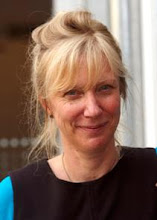
 Mandy Hager is the author of some of the best Young Adult books in New Zealand, including the action-packed The Nature of Ash (shortlisted for the 2013 New Zealand Post Children’s Book Awards). Mandy’s latest YA novel is Dear Vincent, one of the most powerful and emotionally-charged books I’ve ever read (you can read my review here). I had a few questions for Mandy after reading Dear Vincent and she very kindly answered them for me. You can also enter to win a copy of Dear Vincent and read an extract from chapter one at the bottom of this post. Thanks to Mandy and the wonderful people at Random House New Zealand.
- What inspired you to write Dear Vincent?
 It’s always hard to look back and focus on the starting idea, but I’ve been thinking about the issue of suicide for a while now, through my work with youth at risk, and wanted to send a book out into the world that showed the long term pain suicide brings to those left behind, and to explore the seduction of the idea, and how it is possible to resist, given the right support. The problem with the current ‘don’t talk’ policy around suicide is that kids only get to see the outer manifestations of grief when someone they know kills themselves – the memorial pages on facebook, the highly emotional services – it runs the risk of making suicide seem ‘sexy’ to young people – a kind of ‘you’ll all be sorry and celebrate me like this when I’m gone’ mentality. It also denies those who have contemplated or attempted suicide a voice to say how relieved they are that they didn’t go through with it – and to share the things that helped stay their hands. And I wanted to show that suicide leaves the surviving family with such terrible guilt and grief – for kids to understand the full impact of a suicide on those left behind. I wanted to de-glamourise it – so that it underlines the finality of such a decision – that ‘dead’ means ‘dead’ – no going back, no second thoughts.
I also love Vincent Van Gogh – so it was a perfect opportunity to explore his life and paintings more fully.
- You tackle some tough issues in the book, including suicide and physical and emotional abuse. Was it a story you felt you had to tell?
Yes, it’s been in the back of my mind for a long time now.
- What research did you have to do for the book? What was the most interesting thing you discovered about Vincent Van Gogh?
Van Gogh’s letters are now available online – over 900 of them, so I worked my way through them and also some biographies and documentaries (plus, I had studied him for art history at school many hundreds of years ago!) The first thing that surprised me was just how elegant and literate he was – he’s often made out to be this crazy, rough, boorish man, when nothing could be further from the truth. His letters are beautiful, vivid and incredibly sad. The other really surprising thing was the discovery, through the most recent biography of him by Steven Naifeh and Gegory White Smith, that it is highly likely Van Gogh did not kill himself, but was shot by local boys – though, once shot, he then kept quiet about this act and died in his brother Theo’s arms (in other words, not instigating the act, but not fighting it either.) So it was suicide by omission to fight his injuries or reveal their source. The biography’s evidence for this case is very convincing. Plus, it illuminates more about what was going on in Vincent’s head – for a long time it was thought he was bi-polar, now it seems more likely it was a kind of temporal lobe epilepsy that would descend upon him.
- One of the things I like the most about your books is that your characters are authentic and they feel real. Have you ever been challenged by the ‘gatekeepers’ of young adult fiction because of your characters actions or language?
I haven’t been challenged on this in person, but I am sure there are some people who find the language and issues difficult. All I try to do is be faithful to the character and reflect how I believe they would truly talk, feel and respond.
- There are some very raw emotions in the story and Tara goes to some quite dark places in her head. Did you need to get into the right head space each time you sat down to write or was Tara always with you?
I always sit and centre myself before I write each day, calling the character into my mind. However, there always reaches a point where the character is there all the time until you finish writing – consequently this was a particularly exhausting and grueling book to write. Being inside Tara’s head was an intense experience.
- I love the character of the Professor (Max). How did he come to you?
Max is, in many ways, my father. He, too, was born in Vienna. He, too, was forced to leave with his parents to escape the Nazis. He introduced us to art, music and literature (as did my mother), and was a charming, cultured and kind man.
- Like Tara, does ‘art in all its forms’ have you in its grip?
It most certainly does!
- Do you have a ‘teen test’ for your books during or after you’ve written them?
My first reader, chapter by chapter, is my daughter Rose. She is incredibly good at spotting anything that jars or doesn’t have an authentic ring. I also send the finished draft out to my niece as well (along with several other adult readers) – their feedback is always most welcome and useful.
- Why do you write books for teenagers? What is it about YA that appeals to you?
I think what I like most about YA fiction is that it focuses on strong story and authentic characters. It also appeals to me in terms of who I am writing for – as I tend to write about the things that trouble me, and this primarily is around issues that will affect the up-and-coming generations, it gives me the opportunity to start a discussion with young people about the different ways to look at the world and the challenges they are/will be presented with. So much media these days is controlled by corporate interests I feel it’s important to get alternative thoughts and ideas out there. I strongly believe that only through honest discussion of issues can we ever hope to move forward in a positive way.
Read on for an extract from Dear Vincent.
1
Whenever I tell Father anything, it goes in one ear and out the other, and that certainly applies no less to Mother. Similarly I find Father and Mother’s sermons and ideas about God, people, morality and virtue a lot of stuff and nonsense.
— Letter from Vincent Van Gogh to Theo Van Gogh, Etten, c. 21 December 1881
My father slouches in his wheelchair, a dough ball of resentment. Only the fierce penetration of his eyes registers life behind his rigid face. If he moves at all it is involuntary. The twitch of a finger. The jerk of a leg. But for all his immobility, his presence still looms over us. The gargoyle in the corner. The silent judge.
There is a gritty meanness in his eyes sometimes. Or worse, bottomless sadness — the kind that rakes your soul. Though more often than not these days, anger flares: embers trapped within an iceberg. He is living the inflexibility he’s practised all my life.
Even as I finish hanging out the washing and tilt my face up to the morning sun, I know he will be waiting for me to feed him, wash his face, brush his teeth — all before I have the luxury of heading off to school. Luxury? It’s funny how perspective shifts.
Buttered light filters through my eyelids and I hold my breath, waiting, waiting, waiting, with a sense there’s something I should know. It teases at my memory. Tickles at my nose. I crack one eye open and there’s the clue: a butterfly, chalky white, its tiny dome eyes staring straight back into mine. Of course! How could I forget?
It’s Van’s birthday. The 11th of June. She would be twenty-two today. So old. It’s hard to picture how she’d look. Beautiful? Without a doubt. Respectable? Not for a second. Not my Van. The odds that she’d have turned into a merchant banker, IT nerd or anything, in fact, where she’d have to toe the line are about two billion to one.
Meanwhile, my own life’s reduced to a different numbers game. Nearly six years since Dad’s first stroke. Just under five since we were woken by that gutting midnight call. Three since Mum was forced to take on night shifts at the hospital to pay the mortgage on this shitty hole. One since I began to work half-time to help. And the amount of time I get to lead a normal life? No whole number’s small enough.
‘Tara?’ Mum’s shout repels the butterfly. It flutters off, a ghost adrift. ‘Don’t forget to take the shopping list. I’ll pick you up outside Countdown at ten to nine.’
Does she remember it’s Van’s birthday? Surely she must. But Mum’s declared everything about my sister a no-go zone — as if by refusing to speak of her the past can somehow be erased. If only it was so easy.
Inside, I shoo Mum off to bed before I start on Dad. Her shifts play havoc with her sleep patterns — and her moods. She’s turned into one of those wizened peasants Vincent loved to paint: a small grey shadow, sour and disconnected, all joy in life sucked out of her.
While I’m waiting for Dad’s porridge to cook I eat the last of the bread, sandwiching a scummy wedge of budget cheese. Our cupboards will stay bare until I’m paid later today and do the shop. When we were small, the only time Mum used to make a fuss was over birthday breakfasts: an Ulster fry with bacon, eggs and sausages, and golden crisp potato farl. Now the only fuss she makes is the kind I hate — the kind Van called Mad Cow Disease to wind her up.
I mince Dad’s morning medication into dust and smother it with yoghurt. Pop it in his drooping mouth, scraping the teaspoon across his lips to catch the overflow before I stuff the dregs back in. He shudders as he swallows, his eyes saying it’s my fault that it tastes like shit. I help him drink a sip of water, then cool his porridge with milk and coax it in, one spoonful at a time. I know I should be chatting to him, helping pass the time, but, really, what is there to say? Do you know what day it is? Does the thought of Van thump you in the guts like it does me? Even if he could answer, he’d only throw it back at me. Wind yer neck in, girl. You’ve got a face on like a Lurgan spade.
By the time I’ve finished everything with Dad I’ve less than half an hour to get to school. Who’d have thought I’d ever want to spend more time there, but with my rest home shift starting at two it pretty much wipes out the afternoon.
All I really want to do is paint — hide out in the art room and let the colours wash through me in a heady rush. Vincent says to attack a painting the way a lion devours meat, to call on the grain of madness that is the best of art. Imagine trying to explain all this to Mum and Dad. They view creative madness as a sin on par with striking a priest.
I park Dad in front of the TV and head off on my bike. Our street is full of tacky mansions, but ours is the doozy that drags the others’ values down. Good old leaky home syndrome. The day Mum finally admitted we had no money to fix it or to chase the builders through the courts I cried — I’d had a gutsful of our neighbours’ snide remarks.
‘You think your life is difficult?’ she’d said. ‘Try walking to school in Belfast when the Proddies are on the march.’ She talks about the Troubles the way the old boys in the rest home remember El Alamein.
Since then I’ve built a force field that shouts ‘fuck off’. You have to in a school like mine, where the fact I used to go to the best private Catholic school is all the ammunition the gangs need. In my first week they bullied me out of my iPod and mobile phone and stripped the Nike jacket off my wimpy back. Admittedly I’m safer now. Three years on and we’re dirt poor — I don’t even have an internet connection at home, let alone a replacement phone. There’s nothing left to nick.
 For the most distinguished contribution to literature for children aged 0-15.
 For the most distinguished illustrations in a children’s book.
 A boy named Seth drowns, desperate and alone in his final moments, losing his life as the pounding sea claims him. But then he wakes. He is naked, thirsty, starving. But alive. How is that possible? He remembers dying, his bones breaking, his skull dashed upon the rocks. So how is he here? And where is this place? It looks like the suburban English town where he lived as a child, before an unthinkable tragedy happened and his family moved to America. But the neighborhood around his old house is overgrown, covered in dust, and completely abandoned. What s going on? And why is it that whenever he closes his eyes, he falls prey to vivid, agonising memories that seem more real than the world around him? Seth begins a search for answers, hoping that he might not be alone, that this might not be the hell he fears it to be, that there might be more than just this…
 The last person Zac expects in the room next door is a girl like Mia, angry and feisty with questionable taste in music. In the real world, he wouldn’t—couldn’t—be friends with her. In hospital different rules apply, and what begins as a knock on the wall leads to a note—then a friendship neither of them sees coming.
 Years after a violent war destroyed much of the world, Kaspar has grown up in a society based on peace and harmony. But beyond the city walls, a vicious band of rebels are plotting to tear this peace apart. It is up to the Guardians – an elite peacekeeping force – to protect the city, without ever resorting to the brutal methods of their enemy.


 As children, Logan’s grandfather and his sister Mavis spotted a beautiful and unusual bird in the kowhai tree outside their house: it was a huia, which was believed to be extinct. In an attempt to photograph it they tracked it deep into the Manawatu Gorge. This was a dangerous journey, made even more so when the Carson boys got wind of their mission and decided to try and find the bird first so they could shoot it and sell its highly valuable feathers. More than 60 years later, 11-year-old Logan has returned to the Manawatu with Grandpop and a scientist to try to solve the mystery of what happened to the huia all those years ago. Can the group rely on Grandpop’s version of events, and find the huia’s final resting place? Will the huia still be there, and will its DNA still be valuable for scientific research into NZ’s native fauna? Not if the Carsons have anything to do with it.
 Jamie Reign was born twelve years ago, on the first day of the Chinese Year of the Dragon. This supposedly auspicious start in life hasn’t been much use to him, living a loveless existence with his abusive father, Hector, on a salvage boat. Jamie’s mother Mayling died on the day he was born. When Jamie inadvertently summons some fiery orbs from the air to tackle some local bullies, he doesn’t understand that he has tapped into The Way, the universal energy source, and in doing so he sets off a chain of events with unforeseen consequences. Whisked away by the mysterious Mr Fan to the Chia Wu, a school for students with special abilities, Jamie is taken under the wing of the legendary Kung Fu Master Wu. It is believed by Master Wu and his staff that Jamie is the Last Spirit Warrior, and as such his life’s purpose is to right the dreadful wrongs (climatic and political) taking place in the world. But not everyone believes so – and Jamie himself has doubts. What use is a Spirit Warrior who is hopeless at Kung Fu?
 Callum thought things would be better after he and his friends defeated the evil Lester Smythe, but his world has just begun to crumble
 When the Langur monkey troop rises to power on the dusty streets of Calcutta, it is at a price. A brutal massacre drives the Rhesus troop out of the place they called home and forces them to embark on a dangerous journey. But one Langur monkey, Mico, is prepared to stand up to the tyrannical Langur regime and fight for truth, friendship and love. As Mico uncovers the secrets and lies at the heart of the corrupt Langur leadership, he quickly realizes he is playing a dangerous game. And when monkeys turn on each other, there can be no survivors
 Tim’s diary charts the arrival of his mysterious Great Aunt Emma, an old lady who appears grinning on his doorstep and decides to stay. Nicknamed ‘Grinny’ for her constant eerie smile and mindless chatter, at first their aunt seems to be strange but harmless. But when Tim and his sister Beth make a horrifying discovery about their visitor, they realise that the safety of the entire planet is in jeopardy, and the silent invasion has already started.
 Where can you find shelter in a city of the damned?




 My Best Friends Are Books