Interview with Mark Smith about The Road to Winter

Mark Smith is the author of the amazing new YA book, The Road to Winter.  I absolutely loved The Road to Winter, from the first page to the last!  It’s a thrilling story of survival in the aftermath of a virus that wipes out the population. Check out my review here.

I was thrilled to have the chance to interview Mark about The Road to Winter.  Read on to find out what he couldn’t live without, what inspired him to write The Road to Winter and what books you should read next if you like his book.
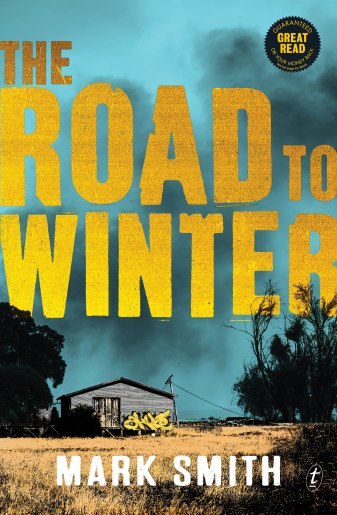
9781925355123

  • What inspired you to write The Road to Winter?

The Road To Winter (TRTW) evolved from a short story I wrote in 2013, entitled Breathing In and Out. When I decided to turn it into a novel I was determined to write a page turner that would engage younger and older readers alike. It is largely an adventure story told through the eyes of a sixteen year old boy – but it touches on a number of very relevant issues, including conflict, attitudes to violence, relationships, loyalty and the treatment of asylum seekers.

  • The Road to Winter is set in the aftermath of a virus that wipes out a significant part of the population.  Would you survive if you were in Finn’s position?

I’d like to think I would! The advice when writing is to “write what you know” and Finn’s understanding of the environment – and how to survive in it – is largely my own. He hunts, fishes, grows veggies and trades food. I think the hardest test Finn faces is the isolation – which, of course, is broken when Rose arrives in town in need of his help.

  • What is one thing that you absolutely couldn’t live without?

Coffee! I actually thought of weaving that idea into the story somewhere but it didn’t make the cut. When you are creating a dystopia there are lots of these decisions you need to make – what’s still there and what’s not. In TRTW though, I deliberately didn’t take a lot of time to explain the dystopia because I wanted it to be a character driven novel, rather than one dealing just with the consequences of living in a post-apocalyptic world.

  • Finn has his dog Rowdy but who would you want by your side if you were in Finn’s situation?

Finn feels the loss of his family very deeply and I certainly would too. If I were forced to survive in a world like his, I’d want my family there with me to help!

  • What is your favourite survival story and why?

As an outdoor education teacher I’m a huge fan of adventure non-fiction. I consume books about survival in extreme circumstances – Jon Krakauer’s Into Thin Air and Joe Simpson’s Touching The Void. Simpson’s story is an incredible tales of survival. I’d also recommend the account of Ernest Shackleton’s epic journey of survival in Antarctica in 1914 and Tim Cope’s On The Trail of Genghis Khan.

  • The Road to Winter is your first book.  How was your road to publication?

By 2014 I’d had more than twenty short stories published in magazines, journals, anthologies and newspapers in Australia. I learned my craft as a short story writer but I always wanted to write a novel. It took me 18 months to get the manuscript of TRTW ready to submit to a publisher. I chose Text because they have a strong reputation for supporting new writers. They loved the manuscript and offered me a three book deal. The sequel to TRTW is due for release in May 2017. I know the road to publication is a long and difficult one for most writers and I am incredibly thankful that mine was relatively smooth – but, in the end, it’s the quality of the writing that will decide whether your work is published or not.

  • The Road to Winter is marketed as YA but it has the look of a gritty adult thriller.  Did you write it for a particular audience or just because you wanted to tell this story?

It’s a really good question! I didn’t consciously write a YA novel – I wanted to tell a particular story in a particular way – through the eyes of a sixteen year old boy. I do think that we often categorise books by their protagonist rather than by what the story is saying and whom it may appeal to. I think TRTW will crossover into the adult reading market very easily – and Text have printed it in trade paperback format to encourage that. As you say too, it has the look of a gritty adult book – again, the cover design being part of the crossover appeal.

  • What other books would you recommend for fans of The Road to Winter?

In writing TRTW I was influenced by reading a number of books – some obvious, some less so. The obvious ones are John Marsden’s Tomorrow series and The Ellie Chronicles. But I also enjoyed The Dog Stars (US) by Peter Heller, Clade by James Bradley and Jasper Jones by Craig Silvey.

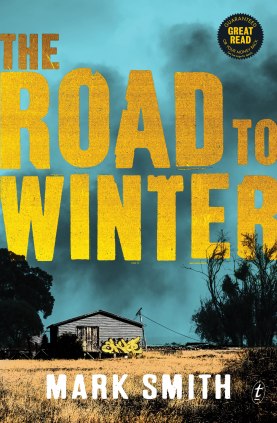
The Road to Winter by Mark Smith

Sometimes you get that feeling when you start reading a book that you know you are going to love it.  Something about it, whether the characters or the tone of the story just clicks with you.  Mark Smith’s debut novel, The Road to Winter, is one of those books for me.

9781925355123Since a deadly virus and the violence that followed wiped out his parents and most of his community, Finn has lived alone on the rugged coast with only his loyal dog Rowdy for company.
He has stayed alive for two winters—hunting and fishing and trading food, and keeping out of sight of the Wilders, an armed and dangerous gang that controls the north, led by a ruthless man named Ramage.

But Finn’s isolation is shattered when a girl runs onto the beach. Rose is a Siley—an asylum seeker—and she has escaped from Ramage, who had enslaved her and her younger sister, Kas. Rose is desperate, sick, and needs Finn’s help. Kas is still missing somewhere out in the bush.

And Ramage wants the girls back—at any cost.

I absolutely loved The Road to Winter, from the first page to the last!  It’s a thrilling story of survival in the aftermath of a virus that wipes out the population.  There’s lots of action and twists to keep you reading, but there are also some lulls in the action that give you a chance to breath and prepare yourself for the next part.  It’s a story that I couldn’t stop thinking about either.  When I wasn’t reading I was wondering what was happening to the characters and how the book was going to end.

Finn’s story takes place in the aftermath of a virus that has wiped out a huge percentage of the population.  The virus affected females mostly so it is mostly males that have survived.  Gangs of men, called Wilders, wander the countryside and control the north where Finn lives.  With a lack of females around to keep them in check these men have lost their humanity and have become violent and ruthless.  You certainly don’t want to bump into them!  Finn has hidden himself away in his house, with a secret store of food, gas, and other supplies, and he and his dog, Rowdy, have survived by themselves fine.  However, when Rose turns up, she brings trouble to Finn’s door and his quiet life is disturbed.  Being the kind of guy that he is though, Finn has to help Rose, both to help her hide and recover and to help her find her sister, Kas.

The Road to Winter reminded me of other books that I’ve really enjoyed, including one of my favourite books, Patrick Ness’ The Knife of Never Letting Go.  The tone of the book felt quite similar, as Finn has to try and help the girls escape the clutches of the violent men who want to harm them.  There is the suspense of them evading capture but not really knowing if they’ll be able to outrun them.  The other similarity to The Knife of Never Letting Go that I really liked was the relationship that Finn has with his dog Rowdy.  Rowdy is his constant companion and is incredibly loyal, much like Todd and Manchee.  The story also reminded me of Gary Paulsen’s Hatchet because it’s all about Finn’s survival on his own, becoming aware of the land and the ocean to find hidden trails to get around and hunt for food.

I loved Mark’s characters too, especially Finn.  While the other males have lost their humanity, Finn has held onto his and leaves the safety of his home to go out and try to find Rose’s sister.  He cares for the girls and is willing to do anything he can to protect them and keep them alive.  I loved the special moments of hope that Finn shared with the females in the story.  Even with everything that was happening to them they still managed to laugh and enjoy having full stomachs.

My only complaint with The Road to Winter is that now I have to wait to find out what happens next.  I need to know what happens to these characters and whether they can find some peace eventually.  The book comes with a money back guarantee but you are certainly guaranteed a great read and I highly recommend The Road to Winter.

Petunia Paris’s Parrot by Katie Haworth and Jo Williamson

What present do you get for a girl who has everything?  What could she possibly want that she doesn’t already have?  Why, a parrot of course!

9781760403690

Petunia Paris really does have everything – a swimming pool, a city of toys, and her own personal library.  When her parents ask her what she wants for her fifth birthday she can’t think of a single thing she wants, so she says the first thing that comes into her head – a parrot.  It is a beautiful parrot all the way from Peru, but no matter how hard she tries she just can’t get it to talk.  One day she loses patience and shouts at her parrot but her butler suggests that she ask it nicely why it won’t talk.  Petunia learns exactly why her parrot won’t talk and she sets out to maker it happy.

Petunia Paris’s Parrot is a perfectly pleasant and pleasing picture book.  It is so much fun to read and it gives your mouth a work-out in several places with all the alliteration.  Kids will wish that they were Petunia, with all of her extravagant gifts and a parrot of their very own.

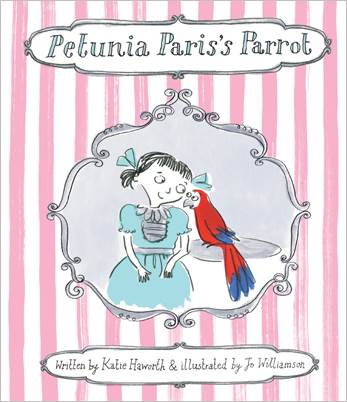
Katie’s delightful text and Jo’s elegant illustrations are the perfect match.  Like Petunia and her family Katie’s text has an air of sophistication.  I almost feel like I should read the book in a posh accent.  Katie uses some lovely language and introduces young readers to words that they’ve probably never heard before, like ‘pertinent’ and ‘perturbed.’ She sprinkles alliteration throughout the text, whether it is Petunia ‘presenting pertinent topics of conversation,’ or ‘planning preposterous new outfits.’  These little touches make the story a joy to read.  My favourite part of the story is when ‘persistent Petunia finally lost her composure.’  I absolutely love Jo Williamson’s illustrations too.  Jo has used mostly pinks and blues in the illustrations, which give them an old-fashioned but elegant look.  Jo includes lots of lavish details that highlight the privileged life that Petunia leads, from her shelf full of toys to the chandeliers in her house and the butler who is holding an umbrella while she swims in her pool.  When Petunia’s parrot shows up he really stands out on the page because of the splash of colour that he brings to Petunia’s life.  Jo has given the parrot lots of expression too, from his determination not to try the exotic food, to his embarrassment over having to wear a silly outfit.

Petunia Paris’s Parrot is delightful from beginning to end and it is sure to be a picture book that will be shared again and again.  I’m certainly looking forward to sharing it with children.

For a sneak peak at Petunia Paris’s Parrot check out the Five Mile Press website.


Win Frankie Potts books

New Zealand author Juliet Jacka has just released her brand new series all about an inquisitive girl called Frankie Potts.  The first two books, Frankie Potts and the Sparkplug Mysteries and Frankie Potts and the Bikini Burglar are out now and are fantastic reads for ages 7-10.  They are full of excitement, adventure and fun.  Check out my review here on the blog.

Thanks to everyone who entered!  The winner is Chris.

A Library of Lemons by Jo Cotterill

Books can give us a window into a different life or show us that we’re not alone.  I had a pretty happy and comfortable childhood so it was books that showed me how other kids lived and some of the tough things that they have to live with.  I think it’s hugely important for kids to read books about all sorts of kids so that they see the world from different points of view.  Jo Cotterill’s new book, A Library of Lemons, gives us a window into Calypso’s life and the ways that her and her father deal with grief.

a-library-of-lemons-488x750Calypso’s mum died a few years ago and her emotionally incompetent Dad can’t, or won’t, talk about Mum at all. Instead he throws himself into writing his book A History of the Lemon. Meanwhile the house is dusty, there’s never any food in the fridge, and Calypso retreats into her own world of books and fiction.

When a new girl, Mae, arrives at school, the girls’ shared love of reading and writing stories draws them together. Mae’s friendship and her lively and chaotic home – where people argue and hug each other – make Calypso feel more normal than she has for a long time. But when Calypso finally plucks up the courage to invite Mae over to her own house, the girls discover the truth about her dad and his magnum opus – and Calypso’s happiness starts to unravel.

A Library of Lemons is a beautiful, heart-breaking story about a family that has lost itself in books.  Jo Cotterill has perfectly captured a love of reading and books.  It’s almost like she has seen inside my head and my heart and put down on paper what it means to be a bibliophile.  Jo makes you feel for her characters, especially Calypso and the situation that she finds herself in.

This is a story of grief and how we all cope with it in different ways.  Both Calypso and her dad retreat into books, Calypso into her stories that take her far away and her dad into the book he is writing ‘A History of Lemons.’ Calypso misses her mum, who died five years ago, but her dad tells her to be strong and that they have ‘inner strength’ to get them through.  Calypso’s dad puts everything into writing his book and often forgets to eat and provide what Calypso needs.  When Calypso discovers what her father has been hiding in his library her anger and sadness comes exploding out of her and sets off a chain of events that will hopefully fix her broken family.

One of the things that Calypso holds on to is her mother’s books.  She knows that she can still be connected to her if she reads the books that her mother did.  This is one of my favourite quotes from the book:

‘Books give you more than stories.  Books can give you back people you’ve lost.’

Anyone who reads this book will wish that they had a friend like Mae.  Not only does she love books and writing like Calypso, but she is always there when Calypso needs her.  She absolutely trusts Mae and confides in her about how she is feeling and the situation at home.  Mae listens to Calypso and gets her mother’s help when she knows they need it.

The ending of the book is perfect.  It shows readers that there is no quick fix to the pain and grief that children and adults face, but over time, things will get better.  It feels very real rather than rose-tinted.

A Library of Lemons is perfect for anyone aged 9 and up who enjoys stories about families and friendship.  If you love books as much as I do you need to read it too because you’ll see a bit of yourself in Calypso.


Introducing Frankie Potts

Meet Frankie Potts, the village of Tring’s number one girl detective.  She has flaming red hair, a questioning mind and an addiction to gobstoppers.  And she is REALLY good at solving mysteries.

Frankie Potts is the creation of New Zealand author Juliet Jacka.  She’s a new character that kids (especially girls) are going to love.  She’s inquisitive, confident and observant.  She has her eyes peeled for things that look unusual and out of the ordinary.  She carries a notebook everywhere with her and is always making lists of unusual things she sees and mysteries that she needs to solve.

In the first book in this fantastic new series, Frankie Potts and the Sparkplug Mysteries, Frankie finds a stray dog outside her favourite sweetshop and he follows her everywhere.  Her first mystery is:

  1. What’s my (sort of) new dog called, and where’s he from?
    • Waggles from Wichita?
    • Kirk from Canada?
    • Morris from Mozambique?

She decides to name him Sparkplug and everybody seems to go gaga for him, especially her formidable Grandma M.  Her grandma starts to act stranger and stranger and so Frankie adds more and more mysteries to her list.  She sets out to solve them with the help of Sparkplug.

The excitement continues in the second book of the series, Frankie Potts and the Bikini Burglar.  Frankie is on the lookout for a human detective sidekick to join her.  It’s not an easy task, especially when she has to deal with the new boy at school, the mean office lady, her arch-enemy Ralph Peter-McGee and tracking down the burglar on the loose in Tring.

The Frankie Potts series is full of excitement, adventure and lots of fun.  The covers make the stories look really appealing, with Phoebe Morris’ wonderful illustrations on the cover and throughout the books.  The series is perfect for 7-10 year olds, especially those readers who like the Billy B. Brown series by Sally Rippin or the Friday Barnes series by R.A. Spratt.

Stay tuned to read a special guest post from Juliet Jacka and a chance to win the first two books in the Frankie Potts series.

Circle by Jeannie Baker

Jeannie Baker is one of the most amazing picture book creators in the world.  She’s known all over the world for her hugely detailed and textured collages that she creates to tell a story.  Some of her previous books, like Window, have been wordless, but tell incredible stories.  I had the pleasure a few years ago of seeing the exhibition of her book, Mirror, and it was an unforgettable experience.  Jeannie Baker’s new book, Circle, is another stunning picture book that tells the story of the Bar-tailed Godwits.

1458621403158

Circle is an outstanding picture book that, like Jeannie’s previous books, will be treasured by children and adults alike.  You feel that you are holding something precious in your hands when you are reading this book because you can see the love that has gone into the story.

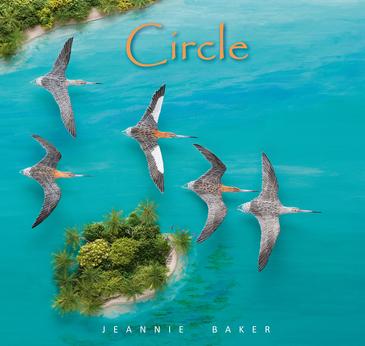
Through Circle Jeannie tells us the story of the Bar-tailed Godwit’s who travel 11,000 kilometres from their breeding grounds in Alaska to Australia and New Zealand.  They follow ancient invisible pathways in the sky, over oceans, cities, icebergs and beaches.  We follow them as they make their journey, make their nests, survive attacks from predators and struggle to find food.

Jeannie travelled to Alaska, China and South Korea in her research for this book and saw the ‘enormous extent of the reclamation and rapid loss of mudflats the Godwits and other shorebirds depend on for food.’ Through her wonderful book she shows us that it is up to us to live our lives without destroying the places that theses birds need to survive.  These Godwits are amazing birds but they also need our help.  Jeannie gives us some more information about the Godwits in the authors note at the end of the book, including a map of their migration.

Jeannie’s illustrations are absolutely beautiful.  You feel like you could reach out and touch all of the details on the page.  Jeannie likes to use textures from the actual materials portrayed in the illustrations, like trees, plants and wool.  The grasses and trees on the first page look so real because they are real. I think it is particularly impressive the way that she creates depth in her illustrations.  There is one page that shows the Godwits flying in a line through the night sky and the Godwits get smaller the further back they are.  You know that Jeannie has had to make some very tiny Godwits for this particular illustration.

There is plenty to see in each of the illustrations, from people doing different activities to the amazing scenic images.  You always discover different things in Jeannie’s books with each new reading and Circle is no exception.  It wasn’t until I reached the end of the book that I discovered there are other migrating creatures to find in the illustrations, like Green turtles and Caribou.

Grab a copy of Circle now and get taken on an incredible journey with Jeannie Baker and the Godwits.  Circle is a must-have for any school or library.


Tickle My Ears by Jörg Muhle

As a father of a 15 month old I’m always on the look out for some great board books to share with my girl.  She will certainly let me know if she doesn’t like a book (either by pointing to a different book or just getting off my lap and walking away).  We love going to the library and she’ll usually choose books that she likes the look of.  Every night we have 2 or 3 stories just before she gets into bed and I love having a bedtime book, one that signals it’s time for bed.  Our favourite bedtime book at the moment is the brilliant board book from Gecko Press, Tickle My Ears by Jörg Muhle.

TickleMyEars_Cover_HR_RGB

Tickle My Ears is the perfect book for bedtime.  It is very interactive, with lots of signs imbedded in this simple story that tell the child that it’s time for bed.  It is short and sweet but fun at the same time.  You have to help Little Rabbit get ready for bed by doing things like fluffing up his pillow (by shaking the book), tickling his ears, stroking his back and tucking him in (by turning the page).  We read this book almost every night so my girl has got the hang of it and will stroke Little Rabbit’s ears and rub his back.  There are some things I have to do myself, like saying ‘Hoppity Hop’ to help him get ready.  The great thing about this book is that it will work for different age groups, whether your baby is talking or just sitting quietly listening to you read.  I love the interactivity of the book and it is simply adorable watching my daughter stroke the rabbit’s back.  I never get tired of reading it and neither does she.

Get your hands on a copy of Tickle My Ears and make this brilliant book part of your child’s bedtime routine.

Are You Sitting Comfortably? by Leigh Hodgkinson

I love books about books and the experience of reading so when I saw Are You Sitting Comfortably? by Leigh Hodgkinson I fell in love.  This wonderful picture book is all about the search to find the perfect place to read.

9781408864821

The story starts like this, ‘The thing is…when I want to read what I really really need is a place to sit…just for a bit.’ The boy in the story tries to describe the perfect place to read, somewhere that’s not ‘buzz-buzzy,’ or ‘slippy, slimy,’ but also somewhere that is not too hot or too cold. He realises that it doesn’t really matter where you sit, but that a book is best when you share.

Kids and adults alike understand the struggle to find the perfect place to sit and read.  In winter I want somewhere warm and in summer I often want somewhere cool.  Leigh perfectly captures this struggle, both in the text and the illustrations.  I love the way that the font changes to match the things that the character is describing.  When the boy is talking about a place being too itchy and fuzzy the text looks fuzzy.  I also love the way that the chairs change size, shape and pattern to match what the character is describing.  The ‘buzz-buzzy’ chair has flowers all over it and ‘stinky grimy’ chair has a pattern of wafting stink lines.

Are You Sitting Comfortably? is the perfect picture book to curl up with and share with your little book worms.

Let’s Play by Hervé Tullet

Hervé Tullet is the master of interactive picture books.  They are picture books for the ‘app generation,’ those kids who have grown up with electronic devices from a very young age.  Much like apps Hervé’s books get kids tapping, swiping, tilting and mixing but on a page instead of a screen.  I’ve loved Press Here and Mix It Up! and his latest book, Let’s Play, is just as much fun.

1094 LetsPlay_CVR_2.indd

Let’s Play takes readers on an adventure with yellow dot that is full of movement, colour and silliness. Yellow dot talks directly to the reader, giving instructions and asking for help, so the book will keep kids engaged.  There are all sorts of concepts included in the book, from colours and numbers to following a line with your finger from left to right, which helps the development of writing in young children.

Let’s Play encourages kids to play and explore and shows them just how fun a book can be. Like Mo Willems’ excellent ‘It’s a Book,’ Let’s Play is a book that really celebrates paper books. It’s the perfect book for one-on-one sharing or for older children to enjoy by themselves.  Fans of Hervé Tullet will love this new book and it’s sure to capture new fans both young and old.