This is a recent video that Chris Morphew posted on YouTube about his fantastic Phoenix Files series. I’m a huge fan of The Phoenix Files and highly recommend it (especially for fans of Michael Grant’s Gone series).
author interview

Interview with Myke Bartlett, author of Fire in the Sea
Today I have the pleasure of interviewing Myke Bartlett, winner of the 2011 Text Prize for Young Adult and Children’s Writing, and author of the fantastic Fire in the Sea (you can read my review here). I asked Myke a few questions about Fire in the Sea, his characters and his writing experience. Thanks Myke!
1. What inspired you to write Fire in the Sea?
 Being a teacher, really. There’s nothing better than seeing kids excited about books and I started feeling a bit envious about the attention other authors were getting. I was determined to write something exciting and challenging that students would enjoy. I think I also really liked the idea of YA fiction being gateway fiction. These were the stories that would, hopefully, get kids hooked on good quality books. If they were reading something good when they were young, then they might demand better when they were older.
2. Had the story been bubbling in your head long before you submitted it for the Text Prize?
I think I had the basic idea about Jake in 2009. But I didn’t start writing it until 2010, as I was working on something else. The actual writing was incredibly quick and painless, probably about six months in total on the first draft. It was a near run thing to get it in on time to Text. I think I posted it off on the last possible day.
3. How did it feel to win the Text Prize?
Unreal. In every sense of the word. I’d written the story specifically to win the Text Prize, so I suppose I felt as if I had achieved exactly what I’d set out to do. That was a great week. And then the editing process began… Which was also great, to be honest.
4. Mythology plays an important part in Fire in the Sea. Do you have a special interest in mythology and ancient cultures?
 I’m probably much more interested in the real world, actually. But I was obsessed with that stuff as a kid. When I got older, I was more interested in ghosts and folk legends and things like that. Things that seemed like they might almost be real. That’s my favourite area of fiction — you know, through a glass darkly stuff. The sense that there might be a monster under the bed, or vampire bats in the fig tree. I think I drew on my memories of mythologies because they’re really where storytelling started. They were the first big blockbusters. Who wouldn’t want to borrow a bit of that genius?
5. Who was your inspiration for the character of Sadie?
I don’t know if I should say. There’s a lot of me in there, really. All that standing at the edge of the world, gazing at the horizon stuff. That’s me. That was me growing up in Perth and dreaming of the world outside. There’s quite a lot of my youngest sister in there too. All the difficult, dogmatic bits! No, my sister is pretty awesome (not that I’d tell her), so I probably borrowed of Sadie’s better qualities.
6. Why did you decide to set the story in Perth?
Because it felt like the sort of place where you’d never expect a story like that to be set! I wanted to tell a big, Hollywood-style story in a small place at the end of the world. Growing up in Perth, I would have loved to think that life could be exciting where I was, instead of thinking adventures only happened elsewhere.
7. Which of the ancient ones are you most like?
Ooh, tricky! Well, I’m quite fond of Agatha. When we make the TV/film version, I’d love my aunt Nicola Bartlett, who’s an extraordinary actress, to play her. I think I gave Jake some of the seriousness and the old-mannishness that I had at that age. I was in such a hurry to be old. I dressed like an old man. It’s only now that I am (relatively) old that I’ve started dressing like a teenager.
8. Do you plan to return to Sadie, Jake and the ancient ones in the future?
I do. They will return! As of today, I’ve written about six chapters of the sequel. Writing is either sheer pleasure or sheer pain (it changes on a day-by-day basis) but it feels pretty exciting to me. There are new (old) monsters, old (new) friends and possibly a car chase. If you can do a car chase in print. Can you? I’m about to find out.
Share this:

Interview with Christopher Paolini, author of Eragon
Christopher Paolini, the author of the Inheritance Cycle, came down to Christchurch at the weekend for the Armageddon Expo. Along with hundreds of other fans, I went along to listen to Christopher talk about his books and get some copies of his books signed. I caught up with Christopher to ask him a few questions about his books and writing.

- What inspired you to write the Inheritance Cycle?
Boredom, mainly, and the desire to have adventures myself. Growing up, I never wanted to be a writer. No, I wanted to be flying dragons and fighting monsters! But since I couldn’t do that, and since I had a lot of time on my hands after I graduated from high school at fifteen (I was homeschooled my whole life), I decided to write my daydreams down. Fortunately for me, enough people around the world have enjoyed reading them that I get to tell stories for a living.
- How do you keep track of all the different characters within the world of your books.
With lots and lots and lots of files. I didn’t used to do that when I started Eragon, but very quickly I found myself with so many characters, I couldn’t keep track of all of them in my head. So I started writing them down in a file, along with all of the words of my invented languages, timelines, and so on. It can be a bit tedious, but in the long run, it saves a lot of effort.
- How did it feel to get your story published when you were so young?
 Well, it was gratifying to know that people actually wanted to read something that I had written. And it was really neat to see my books shelved in the library and bookstores just like all of the books I had read growing up. But at the same time, it was a strange experience to go from a rather rural upbringing in Montana to traveling all around the world and talking to thousands of people at a time. Writing and publishing these books changed my life completely, and again, I’m grateful for the opportunities they have given me.
- The Inheritance Cycle has been a huge phenomenon. Do you feel any pressure from your fans to write something just as amazing, or even better, next?
Not really. I like to think that whatever I write next will be better than what I’ve written before (I’ve learned a lot from each book, after all), but either way, I’m happy with what I accomplished with the Inheritance cycle, and it won’t bother me if my future books aren’t as popular. When I started Eragon, I was just trying to write the sort of story that I wanted to read myself. Moving forward, that’s all I can hope to do. I can’t write to please others, only myself.
That said, I do think you’ll enjoy my next book. 🙂
- How did you find the experience of your book being made into a film?
Strange and surreal! I’m glad that the movie was made—very few books are ever adapted into films, after all—and I gave as much input as I could into the process, but ultimately, the movie reflects the director’s and the studio’s vision of the story, even as the books reflect mine. Hopefully we’ll get some more movies in the future, though.
- What books would you suggest for anyone that loves the Inheritance cycle?
Dune by Frank Herbert, Magician and sequels by Raymond E. Feist; A Wizard of Earthsea and the first two sequels by Ursula K. Le Guin; the Belgariad, the Mallorian, and the Elenium by David Eddings; Memory, Sorrow, and Thorn, by Tad Williams; the Gormenghast trilogy by Mervyn Peake; The Worm Ouroboros by E. R. Eddison; the Dragonriders of Pern series by Anne McCaffery; the Pit Dragon trilogy by Jane Yolen, the Redwall series by Brian Jacques; Fablehaven and sequels by Brandon Mull; and many, many more.
- Why did you want to be a writer?
Because I didn’t have anything else to do at the time, and because I’ve always enjoyed creating things with my hands, whether it was knives, swords, drawings, chain mail, or books. Also, because stories (both in books and in other media) touch me in a way that few things in this world do, and I wanted to share that feeling with other people.
- What’s the best thing and the worst thing about being a writer?
Worst thing? Having to sit down every day and work on the same thing for years on end, even if I don’t feel like it at that particular moment. Best thing? Getting paid to describe my dreams for a living, and knowing that what I’ve written has changed people’s lives all around the world.
- If you weren’t a writer what would you be?
A blacksmith, or a professional artist, or a film director. Whatever I ended up doing, I know that I would make things. That’s what I love to do—make things.
- If you could give one piece of advice to aspiring writers what would it be?
Hmm. There’s no way I can restrict it to one piece of advice, so here’s what I always tell aspiring writers, regardless of their age:
- Read, read, read, read. Good writers are good readers. Read what you love, but also read things outside of your comfort zone, because you’ll learn more than if you just stick with what you’re familiar with.
- Write every single day. Don’t wait for inspiration. I only get inspiration about once every three months. In the meantime, I write. I write on weekends, I write on holidays, and I write on my birthday. In short, I write. I do take Christmas off—and of course I can’t really write when I’m traveling—but that’s the extent of it. Writing is like playing a musical instrument: if you want to get good at it, then you have to practice every single day, even when you don’t feel like it. So unless you’re in the hospital—and maybe even then—you better write. Of all the traits an author can possess, persistence is the most important. It doesn’t matter how talented you are. If you don’t practice, you’ll never master your craft. As Calvin Coolidge said: “Nothing in this world can take the place of persistence. Talent will not; nothing is more common than unsuccessful people with talent. Genius will not; unrewarded genius is almost a proverb. Education will not; the world is full of educated derelicts. Persistence and determination alone are omnipotent. The slogan “press on” has solved and always will solve the problems of the human race”
- Write about whatever it is you care about the most. Writing is often difficult, but if you truly care about the subject material, that’ll help you through the rough patches. And it doesn’t matter what your interests are. Just don’t let someone else tell you what you should or shouldn’t write. If you want to compose a twelve-volume epic about singing toasters and flying unicorns … then go for it! There are over six billion people on this planet. Through sheer odds, I guarantee that there are lots of other people out there who like the same things you do, no matter how obscure they might be.
- Learn everything you can about the language you’re writing in. Grammar is boring, I know, but the better you understand your language, the better you’ll be able to get what’s in your head onto the page and into someone else’s head.
- Find someone in your life—friend, family member, teacher, librarian, etc.—someone who is a good reader, who likes the sort of thing you’re writing, and who can help edit your work. As painful as editing can be, I guarantee that you’ll learn more from editing than you ever will from just writing. The trick isn’t just to perform (and make no mistake, writing is a performance), the trick is to perform and to consciously evaluate what you’re doing so that you can improve. For example, when singing, it’s sometimes hard to hear if you’ve hit a bad note. That’s why every professional singer goes to a voice coach. Sometimes more than one. Writing is no different. Your trusted readers, your editors, are your voice coaches. Listen to them, and you’ll improve at your craft far faster than you would otherwise.
- This doesn’t work for every author, but I would also recommend plotting out your stories beforehand. Again, a musical analogy may serve: it’s hard to compose a piece of music while performing it, so first you compose it, and then you can concentrate upon performing it as beautifully as possible. So too with writing. Also, read the book Story by Robert McKee. It’s highly useful when it comes to learning how to understand the underlying structure of stories. If I try to write without knowing where the story is going, I get instant writer’s block.
- As a corollary to No. 2 – don’t give up. It’s incredibly easy to give up, and there are many, many people in the world who will tell you that you can’t do something. Well, I’m here to tell you that you can, assuming you’re reasonably intelligent and willing to put in the work. Sure, you’re going to get discouraged, and there are going to be days when it seems impossible to finish a book or get it published. That happens to all of us. Even once we’re published. The trick is to keep plugging away and trying to get better.
- And lastly, try to have fun. You don’t have to have fun every day, but try to have fun more days than you don’t. If you can’t, maybe it’s time to think of a profession in a different line of work.

Thank you for reading my books, and I hope you enjoy my future ones even more.
And as Eragon himself would say, “Sé onr sverdar sitja hvass!”
May your swords stay sharp.
Share this:

Elizabeth Pulford talks about Broken
- What inspired you to write Broken?

Several years ago I started a novel for younger children (two chapters) where the brother was missing and the sister knew he was in one of his comics (this was long before graphic art became popular) and then for some reason I left it. When I came across it three years ago I still liked the idea, but wanted it to be more than ‘just an adventure inside a comic,’ and I wanted it for older readers. So I pulled it out and started work. Or should I say I sat at the computer wondering how to make it into something different than I had ever done before. Slowly, slowly it began to happen. Then Trace appeared and when she did I knew she was talking to Zara in a coma. That was the turning point for me.
- There are several different threads of the story; what is happening in the hospital room, Zara’s search for her brother, and Zara’s memories. Did you write each of the threads separately and piece them together or did you write the story from start to finish?
Every day the story came to me in what felt like different pieces, but the end result is how they went down, were written at the time, bar editing etc. The truth was I just had to trust the writing process. I had no ‘map’ for the book, no preconceived ideas of what I wanted, or how it would turn out. I just simply carried on with my daily writing of ‘sections’ and followed the ‘threads’ and thankfully as the novel grew all the bits and pieces somehow it all fitted together.
- Zara has a strong relationship with her brother, who she feels she can share everything with. Is the character of Jem based on your brother?
Goodness me – no! We are good friends, but beyond that…! However, I did lose a brother when I was very young and he was even younger. Maybe the subconscious held onto that and allowed it to surface for this novel.
- The style of the story is really unique. Why did you decide to tell parts of the story through Jem’s favourite comic?
It was there right from the beginning, as I said, when I started the book as a junior novel, at least ten years ago now. I just thought it would be fun and interesting to have someone believing that they were in a comic. In the world of make believe anything is possible, which is what I love about writing.
 Elizabeth Pulford’s new YA novel, Broken, is out in Australia and NZ now. You can read my review of Broken here on the blog.
Share this:

Carole Wilkinson’s Dragonkeeper Blog Tour – Day 6
Today I’m joined by Australian author Carole Wilkinson, author of the wonderful Dragonkeeper books. Carole has just released the 4th book in the Dragonkeeper series, Blood Brothers, and the whole series now has a fantastic new cover design. I really enjoyed the first 3 books in the series, which I read many years ago, so I’m looking forward to getting back to that world again.
Thanks for joining me Carole!

It’s great to be travelling across the Tasman for today’s blog, hosted by Zac at the My Best Friends are Books blog. I’m writing about creating some of the characters in the Dragonkeeper series.
A Reluctant Heroine
Creating convincing characters is perhaps one of the hardest things about writing fiction. I rarely base characters on people that I know, not consciously anyway. When I created the main (human) character for Dragonkeeper, I wanted her to start with nothing. Absolutely nothing. Not even a name. And so I created a slave girl who has no freedom, no possessions, no friends. What she does have is resourcefulness. She has learned to make the most of her miserable life — finding a friend in a friendless world (Hua her pet rat), collecting a few precious items to call her own (a rusty iron blade, a white eagle feather, a piece of weathered wood shaped like fish) and enjoying simple pleasures such as a warm fire and a bowl of lentils flavoured with some purloined ginger.
I didn’t want her to be someone who has always known she was special, or who always had a dream to achieve something grand. At the beginning of the story, Ping has no expectation of any aspect of her life changing. She isn’t craving freedom, she just makes the best of a bad situation.
When offered escape she doesn’t snatch it, she hangs back and has freedom more or less forced upon her. When told she has latent special skills and the opportunity to take up an important role, she doesn’t believe it. That can’t be her. She struggles with her role as dragonkeeper.
Back in 2001, when I started writing Dragonkeeper I didn’t realise how much of me there was in my main character. Just like Ping needed a push to begin my journey to becoming a writer. I had absolutely no confidence that I could achieve that goal.
Inspiration for the Timid
When I was young, there were always those girls who effortlessly excelled. They were natural athletes or had a talent for music or were clever enough for maths and Latin to be a breeze. They were the ones teachers loved. I wasn’t sporty or musical, and I got average marks. I might well have been good at writing stories, but no one asked me to do that. Classes had 40-plus students and teachers didn’t remember my name.
I wanted Ping to be a character to inspire girls who are average and insecure, whose talents are hidden or yet to be acquired by years of hard work.
Draconic Characters
One of the most enjoyable aspects of planning the Dragonkeeper series has been creating the characters of the dragons. First there is Danzi who is frustratingly uncommunicative and past his prime, but who has a quirky sense of humour. In Garden of the Purple Dragon there is Kai, a cheeky dragonling, easily bored. Then in Dragon Moon I got to create a whole cluster of dragons — eight of them, all with very different characters.
I drew on Chinese mythology for the basic characteristics of the dragons — their colours, ability to shape-shift, and the fact that they hibernate in deep pools — and then developed these features. Chinese dragons come in five different colours — red, yellow, black, white or green. I started by deciding that each colour would be like a subspecies with its own characteristics. Red dragons are the biggest, with horns up to a metre long and blue whiskers. They are mediators. They can’t shape-change, but they can camouflage themselves. White dragons are the smallest and the best fliers. They can only shape-change into white birds. The yellow dragons are timid and they sing. The black dragons are more solitary. Unlike all the other dragons, they don’t like water much. They are bad-tempered and prone to fighting, but fiercely protective of their cluster. And the green dragons are natural leaders with exceptional shape-changing skills. They are as at home in the water as they are in the air.
Not all my dragons remain true to type. In the latest book in the series, Blood Brothers, Kai has lost interest in being a leader, and gentle Sha has undergone a radical personality change. I’m looking forward to developing the characters of my other dragons in future books.
Carole Wilkinson
Blood Brothers, book 4 in the Dragonkeeper series. Out now!
Share this:

Interview with Phoenix Files author Chris Morphew
 Chris Morphew is the author of the action-packed Phoenix Files series, about a group of teenagers who have 100 days to stop the world from ending, and he’s also one of the authors who write the Zac Power series (under the name H I Larry) . I got the chance to ask Chris a few questions when he came to Christchurch last year.
What is it like to be one of the authors of the Zac Power series?
It’s pretty cool! Whenever I visit a school and ask how many kids have read a Zac Power book, I’m always amazed at how many hands go up!
What’s your favourite Zac Power gadget?
I think Zac’s Turbo Boots in Volcanic Panic are pretty awesome. Jetpack shoes powerful enough to blast someone out of a volcano? That sounds pretty good to me!

Zac Power books written by Chris Morphew
What inspired you to write your action-packed Phoenix Files series?
This might sound a bit morbid, but one of the biggest things I want to do with The Phoenix Files is tell a story about hardship and suffering. I want to be really honest about the darkness and brokenness of the world. But I don’t want to stop there. I want to suggest that the darkness and the brokenness isn’t all there is, and that maybe there’s a bigger story being told that makes the bad parts worthwhile in the end.
In The Phoenix Files Luke, Peter and Jordan learn that there is only 100 days until the end of the world. What would you do if you knew you only had 100 days left to live?
I would pray a lot. And then maybe see if I could find a super-powered homeless man to tell me what was really going on.
What was the book you loved most as a child?
That’s a tough one! There are so many!
Fiction: The Narnia series, Animorphs, Where the Wild Things Are…
Non-fiction: The Bible and books about dinosaurs.
Who is your favourite author/children’s author?
It’s a toss-up between C.S. Lewis and J.K. Rowling.
Why did you want to be a writer?
Because I love telling stories! I think fictional stories have incredible power to help us understand the real world in new ways.
What’s the best thing and worst thing about being a writer?
The best thing is having the opportunity to explore interesting ideas. The worst thing is usually my next deadline. I write pretty slowly, and sometimes it’s hard to keep up!
What advice would you give to aspiring writers?
Write about things that matter. If you care about your story, then other people are far more likely to care about it too.
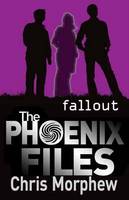 The fifth book in The Phoenix Files, Fallout, is out now. If you haven’t read this amazing series, grab a copy of the first book, Arrival.
Share this:

Interview with Cat Patrick, author of Forgotten and Revived
 Cat Patrick is the author of two of my favourite books, Forgotten and Revived (which you can win here on my blog). Cat’s stories are really original and I always wonder where she gets her ideas. I asked her if she could answer some of my burning questions about her books and her writing so here are her wonderful answers.
- Forgotten and Revived are two of the most original young adult books I’ve read. What inspired you to write these stories?
I really believe that inspiration is everywhere. In the case of Forgotten, it was in my kitchen when I was a new, sleep-deprived mom, and I forgot what I was doing in the middle of an activity. I never remembered, but my brain wandered and landed on the book idea.
With Revived, inspiration came in the form of a news story about a drug that could potentially jolt stroke patients back to normal, read at a time when a family friend’s death from cancer was also on my mind.
- In Forgotten, London can see what will happen in the future, but she can’t remember her past. How did you keep track of London’s story while writing?
I kept memory timeline, and every time I’d sit down to write, I’d also read back a few chapters to make sure I was *forgetting* the right information.
- If you had to live the life of one of your characters who would you choose, London or Daisy?
I think I’d choose Daisy’s life. So much of us is our past—bad or good, it helps shape us. It would be incredibly difficult not to feel lost in London’s life.
- One of the things I like the most about your stories is that the male characters are normal and relatable. Are Luke and Matt based on guys you know?
Luke and Matt are guys I wish I’d known in high school. Sometimes when I read back, I get glimmers of recognition, but ultimately they’re fictional.
- Relationships play an important role in your books. Matt in particular is quite caring and loyal in his relationship with his sister and with Daisy. Do you know before you start writing how these relationships will evolve or does this happen as you write?
It happens as I write. I’m not an outliner. I don’t start books in any sort of organized fashion. Basically, I get the idea, obsess about the main characters’ names, then start typing. The characters take me where they want to go. In the case of Matt, I’m happy that he turned out to be such a good guy.
- Each time Daisy is revived she has to move to a different city. If you could relocate to any city in the world what would it be?
Oh goodness, that’s a long list. If I have to pick one, I’d say London. I spent two days there once. I fell in love and desperately want to go back.
- I love your Australian book covers for both Forgotten and Revived because they stand out and look really appealing. Which editions have your favourite covers and why?
My Australian publisher, Hardie Grant Egmont, has indeed done an amazing job with my covers. Not only are they lovely on their own, but they work well together. For Forgotten, I really love the covers from Australia, UK, Sweden and France. For Revived, the US, UK and Australia covers are amazing.

- What movies/books/music inspire your writing?
I tend to listen to alternative rock—it lets my mind wander to the right place to get inspired. I’ve gotten a lot of ideas while either walking or driving while listening to music. Some of my favorite bands are Arcade Fire, Airborne Toxic Event, Radiohead, Muse, Florence & The Machine, Coldplay and Snow Patrol. And like seemingly everyone in the world, I’ve got Gotye’s “Somebody That I Used to Know” on infinite loop in my brain right now.
As for books, honestly every great read inspires me to be a better writer.
- Your third book, The Originals is due out in 2013. Are you able to tell me a little about the story?
Sure! The Originals is about three identical clones living as one person in order to hide from their past. They split each day, with one going to school in the morning, one attending class and cheer practice in the afternoon and one handling night classes, an afterschool job and other evening commitments. Like Forgotten and Revived, the story offers a mixture of romance and mystery, but it is also an exploration of what it means to be an individual as part of a very unique family dynamic.
Thank you again for the opportunity!
You can follow Cat on her website (http://www.catpatrick.com/), on Facebook (http://www.facebook.com/cat.patrick.7) and on Twitter (@seecatwrite).
Share this:

Interview with CRYPT author, Andrew Hammond
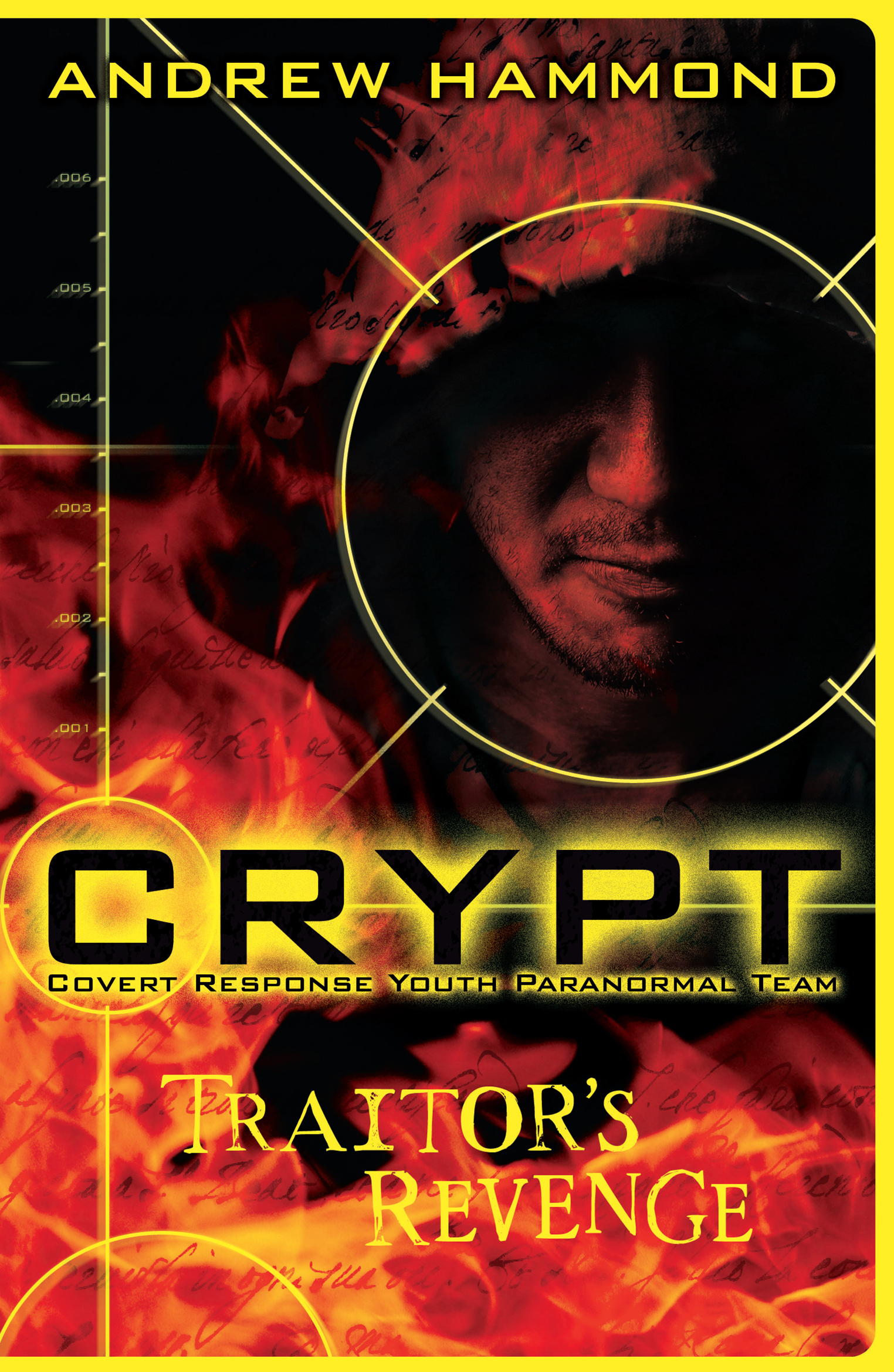 Andrew Hammond is the author of a seriously creepy new series called CRYPT (Covert Response Youth Paranormal Team). The series is about a group of teens who work in a secret government agency to protect the world from paranormal forces. It’s perfect for guys, especially any who like horror or authors like Darren Shan and Anthony Horowitz. Andrew’s latest book, CRYPT: Traitor’s Revenge has just been released in NZ so I caught up with Andrew to ask him a few questions about his books.
1. Did you write a history of the CRYPT organisation before you started writing The Gallows Curse?
Yes, I did. It’s important when writing the first title in a series to ‘redefine the world’ containing CRYPT. Up until that point, there was no CRYPT and so it’s important to consider its history, its future and all the little inconsistencies in between. Readers are sharp these days – and they’ll spot mistakes if I haven’t considered how, why and when it all started.
2. Did you interview real ghost hunters when you were writing the CRYPT books?
Although I have not spoken to a real ghost hunter, I read many books, magazines and blogs written by ghost hunters whilst preparing for this series. I’m keen to use the right equipment and the right terminology, so that it seems as real as possible. But the great thing about ghosts is that everyone has a different opinion about them – so that leaves lots of scope for writers like me. We know so little about what really makes up the universe – even at the atomic level – and so I am open to the possibilities of ghosts. Why wouldn’t anyone be? Without proof they don’t exist, it seems strange not to believe that they do.
3. Are the CRYPT gadgets based on real technology or did you create these?
Yes, every piece of equipment issued to the CRYPT agents is real and available to purchase on line. It’s a well known fact that higher levels of electromagnetic energy are found in haunted places, so I’ve based much of the agents’ work in this area. Energy never dies – it remains as electro static and electro magnetic traces in the atmosphere and in the objects around us, and I believe it’s this energy that ghosts harness to take shape and return.
4. Which of the CRYPT gadgets is your favourite?
It has to be the tri axis EMF detector – it’s faster and more accurate than other detectors at measuring the levels of electromagnetism in the air – often a sure sign that paranormal activity is occurring.
5. Have you witnessed any paranormal events yourself?
Yes. I lived with a ghost for years in a big old Victorian house in Yorkshire, England. We often used to detect strange smells in the house, always around dinner time – the smells of fried onions, herbs, spices, sometimes even roast dinners. But it was never when any of us were cooking. Weird. Eventually we found where the smells were coming from – a small cupboard on the first floor of the house. We opened the cupboard door and were swamped in the smells of something cooking. But there was nothing inside it. We decided to look at the old floor plans of the house, dating back to Victorian times. Then we understood. The cupboard was a recent addition – before it was added there was once a small, spiral staircase which led directly down to the kitchen. That is precisely where the smells of dinner would gently waft into the house every evening in Victorian times.
6. What movies, books and music inspire you?
I don’t watch scary movies or read many scary books – I’m just too easily frightened. I have a vivid imagination and just can’t sleep after something like that. But over the years I’ve found that being so sensitive can make you an effective writer – because I know what fear feels like. I can remember the sweaty palms, the prickly neck, the sinking feeling in my stomach and the palpations in my chest. I don’t wish to numb those senses – not just yet!
Besides, I don’t want to be affected by other people’s notions of what horror could or should be. I like to come at this afresh.
But as a kid, my favourite book was always Arthur Conan Doyle’s Hound of the Baskervilles. I’ve read it so many times now and one summer I even rented a cottage on the fringe of Dartmoor and read it on location. Scary stuff.
7. How many books do you plan to write in the CRYPT series?
There are five books in the series. I’m working on Book 4 right now, which takes us back to Viking times – and some pretty ghastly rituals they carried out on their enemies. I like my history – always have done. I’m pleased to have the opportunity to write about real historical figures, events and places in each of my books. Recently, someone said of my CRYPT series: ‘This is great, history just got scary.’ I like that.
And I don’t plan to kill off the main characters in the final book in the series, as you just never know – there’s a lot of gruesome history out there still to be explored. …
Thanks to Andrew’s publisher, Hachette NZ we have copy of Gallow’s Curse and Traitor’s Revenge to give away. Enter my CRYPT competition to be in to win.
Share this:

Fast Five with Amy Brown
 1. Why did you want to be a writer?
My parents’ house has always had full bookshelves; there are piles of books next to each bed, and even beside the bath. The idea of being able and allowed to write the words in these important objects was thrilling. In Standard Two, I said that one day I wanted to write books for children. After school that day, I asked Mum what she thought I might be when I grew up. When she guessed that I would be a writer, I was delighted at her response. I still am.
2. What’s the best thing about being a writer?
When I’ve been writing for quite a while – perhaps two hours non-stop – the words sometimes begin to come unexpectedly. The chapter unfolds almost as if I am reading rather than writing it myself. Rereading these pages later, I often forget having written parts of them. This is an exciting feeling.
3. What’s your favourite New Zealand book?
I won’t choose a favourite, because it is too difficult. But, I will say that Maurice Gee’s O Trilogy has stayed with me since I first read it nearly twenty years ago. I still have dreams (nightmares?) about Susan Ferris meeting the Birdfolk. I also vividly remember Jack Lasenby’s Harry Wakatipu stories. If you haven’t read them, Harry Wakatipu is a surly talking packhorse who lives with a deer culler in the Ureweras and gets into all sorts of mischief. Recently, I tried to tell a friend the story of when Harry starts illegally tickling trout, but had to stop because I was crying with laughter.
4. What do you love most about New Zealand?
I love that, in New Zealand, you’re never too far from the sea. I also love that you can walk barefoot without worrying about snakes or spiders biting you (I currently live in Australia).
5. What book changed your life?
Because I read it so often, and then later used it as a model for my own books, Jill’s Gymkhana by Ruby Ferguson probably changed my life. Its sense of humour, weird 1950s references to Bing Crosby, and brilliant line drawings have no doubt contributed to who I am today. I admit that it isn’t the best book in the world, but it has been important to me.
Amy Brown is the author of the Pony Tales series, including the latest book, Jade’s Summer of Horses.
Share this:

Interview with Chris Haughton, creator of Oh No, George!

Chris Haughton is the author and illustrator of a very funny new picture book called Oh No, George! It’s all about a naughty dog who keeps getting into trouble and the story will have you laughing out loud. I was lucky to have the chance to ask Chris some questions about his new book and his quirky, colourful illustrations.
- Did you have a dog when you were a kid? If so what was it’s name?
CH: I had 3! Tammy, Tessa and Milly. Tammy was the most like George in personality. She once ate all my Easter eggs.
- What did you do as a kid that made your parents go, ‘Oh no, Chris!’?
CH: Probably annoying my sister. Maybe running after her around the room in a similar way to George and Cat.
- While researching the book you watched lots of guilty dogs videos on the internet. What were some of the worst things that you saw dogs do?
CH: I think 90% of them had eaten something. I was just using google images to see their guilty faces so I could draw them but I noticed there was one dog in particular that kept coming up again and again. The guiltiest dog on the internet! I wondered to myself what on earth had this dog done to have deserved such a reputation and that’s when I discovered that video… (http://www.youtube.com/watch?feature=player_embedded&v=B8ISzf2pryI)
- One of the reasons I love your picture books is because of your bright, bold illustrations. How do you decide what colour pallet to use for your illustrations?
CH: I just work on it as I’m going. I try to make the colours all work with each other and be bright and harmonious but be different enough to provide a bit of contrast and it just happens that it comes out like that. I ignore the ‘real’ colours of the animals and I just use colours in a way that best tells the story. For example the owl is the only thing black against the bright colours of the forest which helps define his shape. George fills so much of the book that he couldn’t be black, I wanted it to be a colourful book and for his shape to be easily recognised so I had him in one block colour which contrasted with the orange background and text. The whites of the eyes (which are the most important thing in every picture) are the only things that are ever white in any of the illustrations.
- As well as being an author and illustrator you’re also a designer. How does your design work differ from your illustration work?
CH: There is a lot of overlap. A lot of the repeat pattern designs that I have done for dresses and clothes at People Tree have found their way into the forest and colours of A Bit Lost and Oh No, George! I think it’s nice to have a bit of variety between the different work I do because it all fuses together somewhere along the line and it helps keep it fresh in both directions.

 My Best Friends Are Books