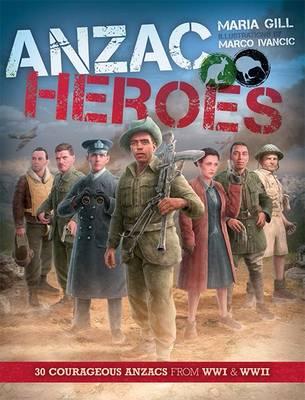
 Maria Gill is one of our queens of children’s nonfiction in NZ. She has written some fantastic books for all ages and on many different topics, from dogs to Kiwi and volcanoes to politics. Some of Maria’s most recent books have profiled remarkable Kiwis from all walks of life. In Maria’s latest book, Anzac Heroes, she tells the stories of the triumphs and tragedies of 30 heroic Australasians during World Wars One and Two.
I had a few questions about Anzac Heroes and Maria Gill kindly offered to answer them for me. Maria talks about some of the extraordinary men and women she discovered while writing her book and the collaboration process with Marco Ivancic. Thanks for joining me Maria!
- Who is the ANZAC that fascinated you the most?
Hard to pin down to one. Charlie Upham, perhaps. Not just for his bravery on the field – he sacrificed his life many times for his men and the Anzac army – but also, for his tenaciousness at trying to escape prisoner of war camps eight times! When he came back to New Zealand, locals had fundraised and bought him a farm to thank for his service to his country. He refused it. As far as he was concerned, unless they were going to give a farm to all the soldiers, he wasn’t going to be singled out for a gift. Australian Joice Loch was another.
- Did you have a personal connection with any of the heroes in your book?
None of the heroes are relatives or friends’ relatives. However, Albert Knight’s story touched me personally. It was very difficult finding any information about Aboriginal soldier Albert Knight. I only found two sentences online about his life. There were no archived newspaper stories about him. Sadly Aboriginal soldier stories have gone unreported. I had to find his family and speak to them. I only had his surname and the town he was born in over 120 years ago. I rang many phone numbers until I found a family member. That person put me on another family member, and they told me to ring another. Between Albert’s relatives, I pieced together his life story. There was a lovely outcome that came out of talking to his family – read his story to find out.
- How did you choose the heroes to be featured in your book?
First I had to define ‘what is a hero’. Then I had criteria. I wanted Army, Navy, and Air Force servicemen. They had to have a range of jobs within those military forces and fight in different places so that I was covering as many of the wartime arenas as possible. Next I wanted four indigenous soldiers: two Aboriginal and two Maori. Lastly, I wanted to include women. Women couldn’t fight in the two wars, but the five women I chose were incredibly brave while operating in the war zones as ambulance drivers, doctors, nurses, rescuing refugees or as a spy. It means there aren’t just Anzac soldiers in the book, but in the Introduction, I say why I included all the others.
- We hear so much about the male heroes but your book also features some incredible female heroes. Can you tell us a little about one of these amazing women?
Dr. Jessie Scott was a young doctor from Canterbury. When she received a personal invitation from the Scottish Women’s Hospital to work in Europe – she caught the first boat out. She had been working in a hospital close to the frontline when the Austrians then Germans invaded Serbia. She and the other doctors decided not to desert their patients. Instead, they stayed. The Germans crammed Jessie and the other nurses and doctors into a train carriage with little food or water. For several weeks, they were taken from one country to the next while the American Red Cross negotiated with the Germans for their release. When they arrived back in London and Jessie was interviewed about her ordeal, she perkily said the Germans had treated them well, and they had enjoyed the scenery. They had only eaten once a day, slept on straw, and the Germans had taken most of their possessions off them. Jessie’s story didn’t end there, though…
- What was your collaboration process like for this book? Did you work closely with Marco Ivancic?
I worked closely with the illustrator and designer of the book. For Marco, I took photographs at museums in Australia and New Zealand so he could use them for photo reference when drawing the pictures. I also spent a day with an Army re-enactment group and took photographs of them doing a drill, acting out a war scene, and holding different guns. They kindly stood still in poses while I took photographs of them at all angles. Marco had asked for close-ups of details on their clothing, how they held a gun and expressions on their faces. The re-enactment group even stood in formation so Marco could see the stance and angles for the front cover illustration. For designer Luke Kelly I gathered different maps of Europe during WWI and WWII and marked in battle zones. I also found all the medals for the heroes, and for the medal page. Sometimes I could not get the real medals that belonged to that hero so had to line single medal images up in order and send to Luke. Luke, Jack Hayes (New Zealand military expert) and I put a lot of work into those medals! I also collaborated with different experts, museums, and Creative NZ enabled it to happen with their grant.
- What does ANZAC Day mean to you? How do you celebrate it?
I believe Anzac Day recognises not only the sacrifice men and women made during the different wars but also the kinship between Australia and New Zealand while fighting. Common themes that resonated throughout the different Australian and New Zealand stories were their comradeship, incredible bravery, modesty, and down-to-earthness. Leaders fought with their men instead of sitting in their offices. It shows how alike Australians and New Zealanders are, compared to other nationalities.
I’m going to attend my first Anzac Day dawn parade this year. I have to confess my only interest, before writing this book, was in reading war stories. I love adventure stories where the hero survives at incredible odds. Most of the heroes in ‘Anzac Heroes’ fit that category.
Anzac Heroes by Maria Gill, illustrated by Marco Ivancic is available now from Scholastic New Zealand.


 My Best Friends Are Books