Fast Five with Jenny Cooper

  • Why did I want to be an illustrator?
I never knew you could be an illustrator, but I always drew, at home, when I was young. Then I grew up and discovered that there was a whole world of picture books for children, and even though I had other jobs like teaching and advertising, I couldn’t help being drawn to children’s illustration, because I had spent so many thousands of hours, as a child, doing that sort of art. So in a way, I had no choice, it just happened naturally.
  • What is the best thing about being an illustrator?
The best thing is when you do a picture that you are really proud of. This doesn’t happen often, usually I am disappointed in my work. But just sometimes, maybe one picture out of 10, I do something that really surprises me, astonishes me and makes me think, how did I paint something that good? When that happens, it makes all the other, average, illustrations, worth it.
  • What is your favourite New Zealand Book?
The Year of the Shining Cuckoo by Joyce West. It is not in print now, I bought it second hand and read it once a year.
My favourite NZ picture books are  probably A Booming in the Night, by Helen Taylor, or Dragor, by Philip Webb
  • What do you love most about New Zealand?
New Zealand to me means freedom and space. I didn’t notice the  space and peace and quiet here until I had travelled in Europe, where the beaches are so full you don’t have room to put down a beach towel. And I can be in the mountains in an hour, if I want, or beside a beautiful clean alpine lake. And I love our relaxed and unfussy way of life, as Kiwis are basically trustworthy and trusting of other people, and I really hope it stays that way. Doors don’t always have to be locked, and a lost wallet will probably be returned, and if you want to live in an unusual way, up a mountain or on a boat, you are free to do it.
  • What do you love most about libraries?
If I go into a library for one book, I always come out with 5, there are so many interesting things to read about. But unlike the internet, where you are alone, libraries are always full of other people. Libraries are friendly, the people are helpful, and I always come out feeling I have spent my time well, and learned something. And of course, the books are free!
Jennifer Cooper is a children’s book illustrator with a background in graphic design.  Jenny has illustrated books for Melanie Drewery, Yvonne Morrison, Joy Cowley, and Jane Buxton, among many others.  Jenny’s most recent collaboration is with the Topp Twins for their version of There’s a Hole in My Bucket and Do Your Ears Hang Low?

Fast Five with Lindy Fisher

  • Why did you want to be a writer?

I can’t seem to help making images. I’ve done it forever! I enjoy texture and colour and playing with it. Sometimes my images are used to illustrate children’s stories, sometimes to feature on NZ postage stamps and other times on peoples walls in their homes.

  • What’s the best thing about being a writer?

Being able to do what I love for my job and introducing other people to the fun I have so they can enjoy it too. Either using their imagination to interpret my pictures or using my techniques to make their own new ones.

  • What’s your favourite New Zealand book?

Always the one I am working on or have just had published. At the moment it is “Remember that November” by Jennifer Beck.

  • What do you love most about New Zealand?

Living by the sea on its gorgeous coast line under some pohutakawa trees.

  • What do you love most about libraries?

That books are free! BUT I never want to take them back!!

Lindy Fisher is an illustrator who has created the illustrations for stories by Jennifer Beck and Dot Meharry, including Nobody’s Dog, A Present from the Past, and Remember That November.

Fast Five with Donovan Bixley

  • Why did you want to be a writer?

I wanted to illustrate things that I was really interested in, which doesn’t always happen when you illustrate other author’s stories. So I decided to write my own stories.

  • What’s the best thing about being a writer?

Coming up with ideas is very exciting. The hard part is the months and years it take to make those ideas good enough. Through a lot of hard work they get turned into a finished book.

  • What’s your favourite New Zealand book? 

“Sydney and the Sea Monster” by David Elliot. I also love “The Word Witch” by Margaret Mahy and David Elliot.

  • What do you love most about New Zealand?

I love that we’re a small country, with a population not much bigger than a city in most countries. New Zealanders are fairly humble and relaxed people on the whole, and not too stressed out. I love being able to enjoy our lakes and mountains and coasts with my family.

  • What do you love most about libraries?

I like browsing the shelves and finding books that I would not normally look at. I still like to get reference books from the library. The Internet is not quite the same.

Looky BookDonovan Bixley is an author and illustrator who has created the illustrations for his own books and for books by other authors.  He has created Kiwi versions of The Wheels on the Bus and Old MacDonald’s Farm, and his latest book is the wonderful Kiwi-themed puzzle book, The Looky Book.  Donovan has also illustrated Brian Falkner’s Northwood and Maddy West and the Tongue Taker, and created the Dinosaur Rescue series with Kyle Mewburn.

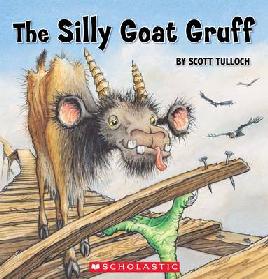
Picture Book Nook: The Silly Goat Gruff by Scott Tulloch

The Silly Goat Gruff by Scott Tulloch is the second fairytale retelling that Scholastic New Zealand have published this month and it’s absolutely brilliant.  Scott Tulloch presents a version of The Three Billy Goats Gruff that you’ve never heard before.

In The Silly Goat Gruff there are three goats called Willy, Billy and Silly Goat Gruff who want to get to the other side of the bridge, where there is lush, green grass.  They get sick of nibbling on pine cones and chewing on pebbles and so they each try to cross the bridge.  But we all know that there is a mean, smelly troll living under this bridge and he’s also hungry.  Just when you think you know how the story goes, Scott turns it on its head.

The Silly Goat Gruff is a hilarious retelling of the classic story, with a twist in the tale that you won’t see coming.  The rhyming text flows perfectly, making it a fun story to read aloud.  Scott uses some wonderful language throughout the story, words like leer, sneered and smithereens, that many children may not have heard before.  I love some of the phrases that Scott uses too, like ‘What the dickens are you doing?’ and ‘I’m scarcely a snack with salad and fries.’  The distinct characters in the story make it ideal for acting out in class, or for a librarian like me to do some great funny voices.  The twist in the story made me laugh out loud because it’s so funny and totally silly.  Needless to say, Silly Goat Gruff has some hidden talents that come in very handy when facing a hungry troll.

Scott’s illustrations add extra silliness and humour to the story.  Silly Goat Gruff doesn’t look the brightest or most handsome goat on the mountain, but I love the way Scott has drawn him, with his tongue hanging out, crooked teeth, and wonky eyes.  I’m sure if you were a troll you wouldn’t feel threatened by him in the slightest.  The moral of the story though is that looks can be deceiving and you shouldn’t judge anyone by how they look.  I also really like Scott’s troll, who looks both scary and cuddly.

4 out of 5 stars

The Silly Goat Gruff is another wonderful New Zealand book that you could borrow from your library or buy from a bookshop (using your NZ Book Month $5 voucher) to share during NZ Book Month. 

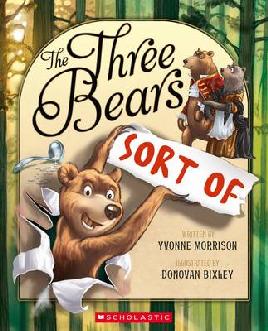
Picture Book Nook: The Three Bears (Sort of) by Yvonne Morrison and Donovan Bixley

If you think you know the story of Goldilocks and the Three Bears then you better think again.  I’m sure you’ve never had a child pointing out the loop holes in the story as you read it before.  This is exactly what happens in Yvonne Morrison and Donovan Bixley’s new take on the story, The Three Bears (Sort of).

A mother starts to read the story of Goldilocks and the Three Bears to her son before bed, but he doesn’t just sit there quietly and listen to the story.  This boy is both switched-on and rather annoying.  His mother can only read a sentence or two before he points out an issue with the story.  First, he wants to know what sort of bears they were (Grizzly bears? Polar bears?). He also points out that daddy bears don’t live with mummy bears (mummy bears raise their cubs alone), that bears don’t have thumbs so they couldn’t pick up a pot for the porridge, and that bears would probably just eat fish instead of porridge.  Every time he questions a detail of the story you wonder why you hadn’t thought of that yourself.

The Three Bears (Sort of) is an entertaining and unique retelling of Goldilocks and the Three Bears that adults will enjoy as much as children.  Yvonne Morrison’s text will have you in stitches! It’s full of sarcasm that adults especially will love and she’s captured the voice of an inquisitive toddler and the mother (who’s making it up as she goes along) perfectly. Donovan Bixley’s illustrations are absolutely wonderful and really match the humour of the story and the way it’s being told.  The hands of the mother and son can be seen on some of the pages, as they draw or add pictures into the story.  Donovan’s Goldilocks looks both cute and bratty, and I love the facial expressions of the bears.  I think Donovan is New Zealand’s own Anthony Browne, because of the way he adds extra details into his illustrations that add another layer to the story.  On the very first page, above the publication details, there are some interesting objects on the mantelpiece, including soft toy bears, a card for a locksmith, and a postcard from Svalbard.  You’ll also notice the tree patterns on the wallpaper.  I also really love the way that Donovan has designed the book, with the son’s interruptions inside a box on the page and in a different, childish font.  This makes it clear to see when the son is talking and when the mother is talking.

It’s perfect for reading aloud one-on-one or with a large group, and it’s ideal for acting out, as one person could be the mother and one person could be the son.  This is how we’ll be performing it at our Three Bears Breakfast at Shirley Library in Christchurch next Saturday (16 March).

5 out of 5 stars

Fast Five with Nikki Slade-Robinson

  • Why did you want to be a writer?

Why not!  I think if the ideas are there, and the characters are demanding to be let out, you don’t get much choice really.  Writing and illustrating was always my dream.  And luckily my parents let me have plenty of paper so I didn’t have to draw and write on the walls.

  • What’s the best thing about being a writer?

Ooooh it’s soooo fun!  I put writing and illustrating together because I do both.  I can spend lots of my day playing with my imagination and not many jobs let you do that.  I love being self employed too, and having so much flexibility.   It’s also very cool when you see one of your books picked up and turned into something else like a show.

  • What’s your favourite New Zealand book?

Oh that’s not fair – there are so many wonderful NZ books, how can I choose just one?  Is it ok to list a few?  I do love Jack Lasenby’s ‘The Lake’ and his Seddon St gang ones.  Nobody can go past Margaret Mahy of course, horracapotchkin! (Oh dear – did I spell that right?)  And I use Andrew Crowe’s ‘Which NZ Insect?’ a lot.  Des Hunt’s books because they are set in areas I know… Joanna Orwin – oh there’s so many good writers here – sigh!  In terms of picture books, that too is really hard to choose.  I just really enjoy being able to read NZ stories.

  • What do you love most about New Zealand?

The environment.  We do live in paradise really, you only need to travel away from here to realise how good we really have it.  And our society, really it’s great.  I just hope we can all look after it and really cherish what we have.

  • What do you love most about libraries?

We’ve got this really old picture book about a little boy who can hold an elephant and a lion and a rocket under one arm.  He can hold anything you can think of under his arm.  And at the end you find out it’s because he can go to the library and get a book about anything out.  Libraries are like that – you can find so much there… and it’s free so nobody has to miss out.

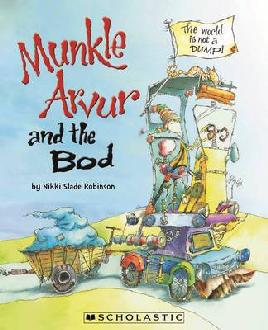
Nikki Slade-Robinson is an author and illustrator whose books include Munkle Arvur and the Bod, That’s Not Junk! and Hannah Bandanna’s Hair.  Nikki has also illustrated books for other authors, including Mind Your Gramma and The Seven Stars of Matariki.

Win The Looky Book by Donovan Bixley

The Looky Book is a cool new puzzle book by New Zealand author/illustrator Donovan Bixley, with 11 different puzzles, all with colourful New Zealand landscapes, birds and animals.  There are heaps of things to find in each picture, like find the numbers with the crazy All Black lambs, spot the difference with the mischievous keas, find the animals hidden deep in the bush, and match the farmers to their animals. You can read my full review and my interview with Donovan here on the blog.

I have a copy to give away and all you need to do is enter your name and email address in the form below.  Competition closes Thursday 1 November (NZ only).

Go back

Your message has been sent

Warning
Warning
Warning

Warning.

Interview with Donovan Bixley

Donovan Bixley is my favourite New Zealand illustrator.  He has illustrated Kiwi versions of The Wheels on the Bus and Old MacDonald, written and illustrated a book about Mozart, called Faithfully Mozart, and illustrated work by other authors, including Kyle Mewburn (the Dinosaur Rescue series) and Brian Falkner (Northwood and Maddy West and the Tongue Taker).  Donovan has just published his amazing Kiwi-themed puzzle book, The Looky Book (which I reviewed here on the blog).  I was lucky enough to be able to ask Donovan a few questions about his illustration, his new book, and working with other authors.

  • Your illustrations they seem to glow on the page.  What materials/tools do you use to create them?

Most of my work is hand drawn and digitally painted. I come from a painting background, and when I was a AUT the first computers came in. I began scanning my paintings and drawings and mucking about with them in Photoshop 1 – ha ha, you couldn’t do much. I’ve kinda just kept working on it for years and years and now that is the thing I am really highly skilled at. If I were more highly skilled at water colours or oils I would use that medium. I usually treat my digital work as a normal painting – however I’m not precious about it (I’m not here to preserve the sanctity of ‘the art’). I have a vision in my head and I’ll use any means necessary to achieve that. I once had a woman come up to me at a Storylines and ask about my illustrations. When I told her they were digital paintings she stormed off in disgust, as if the computer had done all the work – however some of my paintings, such as those from my book “Faithfully Mozart”, take 70-80 hours.

  • Who influences your illustration?

Well I’m still trying to live up to my heroes, like Norman Rockwell. I am huge fan of the turn of the century illustrators like Arthur Rackham, Maxfield Parish and Edmund Dulac and also their modern equivalents, like the brilliant Russian illustrator Gennardy Spirin. A lot of my work features that kind of old-fashioned ornamentation – swirly things just seems to naturally come out. They often get cut out of the final illustrations for various reasons. There are an incredible amount of illustrators who I follow avidly, like Dave McKean, Shawn Tan or John Howe, but usually this is simple admiration rather than influence. It would be pretty hard for someone of my generation not to be influenced by people like Bill Peet or Dr Suess – in fact I spend a lot of time now consciously trying to be influenced by my childhood memories, I especially like a bit of humour such as Mad Magazine or Mordillo. In that way I don’t often seek out other illustrators to inspire me. I find that I am drawing influences straight out of myself – which I suppose is where you get your own style from – all that stuff goes into you and gets all mixed up and eventually after many years you stop trying to emulate your heroes. You are just you.

  • You’ve created Kiwi versions of The Wheels on the Bus and Old MacDonald.  What do you enjoy most about putting your own Kiwi spin on these classic rhymes?

I was a bit apprehensive about doing those two books actually, but what thrilled me about them both was the challenge as an illustrator. One: they’re often stories that get done so badly and I was determined that they had the potential to be really cool. Two: was the open-ness of the text. I often use “Wheels on the Bus” as a perfect illustration example when I’m doing workshops with school kids – because the words don’t constrict your imagination. All it says is “the wheels on the bus go round and round …” and the rest is up to you. So in that respect both of those books were a real pleasure to add my spin and create a whole world outside of the basic text. I loved some of the things that came out of it like ‘The All Black Lambs’ and ‘Squidly’ the colossal squid. Having said that, you’d probably guess from the variety of my other work that I really hate to be pidgeon-holed as an illustrator. I didn’t want to become ‘the guy who does kiwiana versions of old songs’. So that’s how I ended up doing “The Looky Book” – I wanted to take all those characters and situations from “Wheels on the Bus” and “Old MacDonald’s Farm” and do something different with them. So I started thinking about the type of books I loved when I was a kid.


  • Your latest book, The Looky Book, is amazing! There is so much to find on each page.  How did you decide what puzzles and scenes you would create?

It was actually much more difficult that it appears. Since the book is aimed primarily at pre-schoolers, a lot of more complicated ideas had to be thrown out. Yet at the same time I always try and make my books have something to appeal to all ages. There are little things in there that the kids won’t get until they are older, maybe not until they are adults. As an illustrator, that’s an important thing for me, it keeps the illustrations alive, even after years of the reader looking at them, because they’re seeing things in a new light. It also makes the books entertaining for parents to read. Kids are little explorers and I strongly believe in giving them lots of opportunities to discover new things on each page. You’d be surprised how a kid will pick up on a tiny little aspect of a story or illustration and they’ll go off and find out all about it. If you don’t give them those opportunities then the book becomes flat and boring and will only be read a few times. As far as the puzzles that ended up in the book, I really wanted to cover a variety of entertaining visual tasks for pre-schoolers. So among the general ‘I spy’ elements are things like finding numbers, matching colours or patterns, and putting things into groups.

  • How long did it take you to create each spread?  Did you have to plan them in great detail before you started?

I’m not sure how long each spread took, the whole book was a few months work spread over half a year. As I mentioned above, a lot of initial work on sketches for spreads got thrown out for being too complicated. I guess the longest would have taken a week and generally involved quite a lot of planning – more in composition, just to fit everything in. With most of my books I brainstorm a lot with my wife and three daughters, at the dinner table or in the car, coming up with ideas. So I’d have this big list of things that needed to fit somewhere in a spread and then have to figure out where that ‘where’ would be. In terms of sketch planning, I’ve stopped doing highly detailed roughs. I find that I enjoy illustrating, and get much better results, if I leave a lot of room for creativity in the final illustration. For a recent Scholastic book, “The Three Bears Sort Of” by Yvonne Morrison, I didn’t actually do any roughs at all. Instead I sent the publisher a letter telling them what I was going to do and created each page as I went. Luckily they really had faith in my ability to pull it off, and the result was a real creative explosion rather than just the technical process of turning a sketch into a finished illustration.

  • Which spread was your favourite and which was the hardest to get perfect?

My favourite is the underwater scene. It’s a homage to one of my favourite books as a kid, “Patatrac” by Jean Jacques Loup. “Patatrac” is this funny French book from the 70s without words, just crazy pictures with lots going on and no actual story. Books like that and books like Richard Scarry’s were part of the inspiration for the “The Looky Book”. As a kid I could sit for hours just looking at the pictures (actually I still do as an adult). The most difficult illustration was the forest scene, where plants and bushes make up shapes and outlines of New Zealand animals. I often have a really good idea in my head, but then making it work in the real world is a challenge. That picture took a lot of planning and was the longest to create (actually the complete opposite of how I just answered the previous question ha ha). I still worry that it didn’t work quite as well as I’d imagined it.

  • You’ve created some wonderful illustrations for other authors’ work, including Brian Falkner (Northwood, Maddy West and the Tongue Taker) and Kyle Mewburn (the Dinosaur Rescue series).  What’s the best thing about working collaboratively?

I love being able to work with other authors, it means I get the best of both worlds. When there is something I really want to illustrate I create it for myself, but working with other authors allows me to create things that I never would have chosen to do on my own – it always helps if that thing fits into your areas of interest. Brian’s “Maddy West” was a real treat for me – the chance to do ninjas, break-dancing monkeys, witches, wolves and ravens and creepy old gothic houses – all these things fit right into the more serious and darker side of my work, but are far from the humourous subjects I am usually asked to illustrate. “Dinosaur Rescue” is a particular favourite. I mean, I’ve been drawing dinosaurs since I was able to pick up chalk, so it’s a dream come true to be doing it as a professional! It’s also a thrill because there’s so much room for humour and it’s a true collaboration. Kyle creates something, then I take it and add to it, then Kyle comes back and takes the something I did and adds onto that … and so on. Often the best developments are when one of us takes a little aspect, a word or a corner of an illustration, and develops a whole new branch of story from there. Best of all it’s tremendous fun which I hope is apparent to the readers.

  • What are you working on at the moment?

I’ve just this week begun work on a Margaret Mahy book which is a huge honour for any illustrator, and very exciting. Margaret’s work is unlike anything I’ve ever illustrated before. Often I’ll have a very obvious text that drives the illustrations, and within that I create my unique part of the story. Margaret Mahy’s works are perfect for an illustrator because (as mentioned with “Wheels on the Bus”) they don’t constrain you. I can’t quite put my finger on it, but there’s a lightness and freedom. She has an incredible way with words which is just so lovely – words for the joy of words and the sounds they make in you mouth. It’s also a lovely little story too with a nice plot and darling characters. It’s the type of work that could fall very flat or soar, depending on how you illustrate it – and I have to say I’m a little bit nervous, but I have a feeling it’s going to be very delightful.

I’m also working on my next book for Hachette, which is another of my own called “The Weather Machine”. It’s a bit like those books I was talking about above, Mordillo and “Patatrac” – a book without words – which I’ve wanted to do for years. It’s about a man who makes a machine to control the weather, with Frankenstein-ish results.


Thanks for joining me Donovan.  I loved your answers and it’s always great to get an insight into an illustrator’s work.  You can find Donovan at his website, www.donovanbixley.com and on Facebook.

The Looky Book by Donovan Bixley

All kids love a good puzzle book.  When I was a kid I loved Where’s Wally, I-Spy and those pick-a-path maze books.  There have never been any great New Zealand themed puzzle books, until now.  New Zealand author and illustrator, Donovan Bixley, has just published his awesome puzzle book, The Looky Book.  Donovan is my favourite New Zealand illustrator and his illustrations for The Looky Book are wonderful.

The Looky Book is a puzzle book with 11 different puzzles, all with colourful New Zealand landscapes, birds and animals.  There are heaps of things to find in each picture, like find the numbers with the crazy All Black lambs, spot the difference with the mischievous keas, find the animals hidden deep in the bush, and match the farmers to their animals.  My favourite pictures are the ones where you have to spot what’s wrong in the scene.  In the beach scene on the first page, you can find a shark in a paddling pool and a man watching TV in the bath.  There are hours of fun for kids and adults, and when you’ve solved all the puzzles, you can go back and find the tui and the grumpy garden gnome on each page.

I love Donovan’s illustrations and The Looky Book just shows how versatile he is.  Not only does he give each human or animal it’s own personality, but he can make these a small part of a large scene.  He makes every little detail count, and these little details are hilarious (sheep holding up a ‘Lamb Carter’ banner or a penguin wearing a tie).  The reason I love Donovan’s illustrations is because they are always so colourful and they seem to glow.  He seems to use this effect that makes certain objects or characters shine.  Just look at the front cover and you’ll see what I mean (the eyes, the telescope and the kea’s beak).  I would love to know how long it took Donovan to create each spread.

There is an incredible amount to see on each page, and some things you won’t see the first time. Donovan his given the book a real Kiwi feel too, with lots of local wildlife and some Kiwi icons like Hokey Pokey ice cream.  If you have a very keen eye you might even spot a reference to one of Margaret Mahy’s stories on the first page.

Christmas is only weeks away and The Looky Book will make a perfect present for kids young and old.

5 out of 5 stars

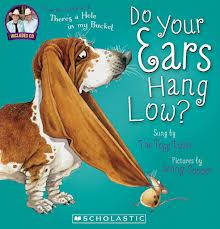
Picture Book Nook: Do Your Ears Hang Low sung by The Topp Twins, illustrated by Jenny Cooper

Last year Scholastic NZ brought Kiwi legends, The Topp Twins, together with one of our top illustrators, Jenny Cooper, to produce a wonderful illustrated edition of the song, There’s a Hole in my Bucket.  Now, this fantastic team have come together once again to produce a very cute and funny, illustrated edition of the song, Do Your Ears Hang Low.

Based on the original song, Do Your Ears Hang Low? is a new arrangement by The Topp Twins, that ties in perfectly with Jenny Cooper’s illustrations.  I’d love to know what came first, the lyrics or the illustrations, because they’re made for each other.  The Topp Twins’ lyrics are funny and you can add some easy actions for children to sing and play along.  Who would have thought there were so many uses for big ears?  The CD of the Topp Twins performing the song (that comes with the book) is a great addition to the book and it’s that classic Topp Twins sound that we love.

I absolutely love Jenny Cooper’s big-eared illustrations!  They’re cute and made me crack up laughing.  Jenny is amazing at capturing animals, especially the wrinkled skin of the dog and the curly fur of the llamas.  The expressions on animals faces are hilarious too.  I love the shock on the dogs face as the mouse ties up his ears, the mellow look on the llama’s face, and the expression of pure joy on the pig’s face.  The animals all look so cuddly and loveable that you just want to give them a big hug.  Book Design have also done a fantastic job of the design of the book, from the layout and size of the very cool font, to the flaps and the cute end papers.

As well as the wonderful song and illustrations, you also get the added extras of some strange, but true facts about ears.  Do Your Ears Hang Low? is the perfect book for Kiwi kids with ears of all shapes and sizes.

4 out of 5 stars