Broken Silence by Helen Vivienne Fletcher

I’ve read my fair share of adult thrillers.  Authors like Dean Koontz and Stieg Larsson have had me on the edge of my seat, reading as fast as I can to find out who did it and why.  I haven’t seen many YA thrillers though, especially not a New Zealand thriller for teens.  When Helen Vivienne Fletcher, a New Zealand author from Wellington, contacted me about reviewing her book I read the blurb and was immediately intrigued.  I needed to read this book about a teenage girl, coping with an abusive boyfriend (among other things) and the stranger on the end of the phone who offers to help.  Helen’s story absolutely lived up to the intriguing blurb and she had me hooked from the very first page.

static1.squarespace.com

A stranger just put Kelsey’s boyfriend in a coma. The worst part? She asked him to do it.

Seventeen-year-old Kelsey is dealing with a lot – an abusive boyfriend, a gravely ill mother, an absent father, and a confusing new love interest.

After her boyfriend attacks her in public, a stranger on the end of the phone line offers to help. Kelsey pays little attention to his words, but the caller is deadly serious. Suddenly the people Kelsey loves are in danger, and only Kelsey knows it.

Will Kelsey discover the identity of the caller before it’s too late?

Broken Silence is a pulse-pounding thriller, full of twists that keep you guessing.  Helen makes you second-guess yourself as you try to figure out who the mysterious caller is.  I can’t think of another book recently that has had me thinking about the story and the characters constantly.  When I wasn’t reading it I was worrying about Kelsey and what would happen next.

Kelsey doesn’t have an easy life.  Her dad walked out on the family, her mum is in a care home with dementia and her boyfriend, Mike, is abusive.  He talks down to her and can turn violent quickly, but will then come back apologising the next day.  He has the worst role model in a violent father who is most often drunk.  Kelsey lives with her brother, Pete, and his flat mates, Aiden and Ben.  One day Kelsey starts getting prank calls, with the person breathing heavily and not saying anything.  The calls escalate to the stage that it’s not just on the home phone and her cell phone, but also on the phone at Mike’s place.  When Mike gets violent after a party the person on the end of the phone offers to help Kelsey.  She tries to break up with Mike but he won’t let this happen and so he attacks Kelsey, leaving her with multiple injuries and unconscious.  When she wakes up in the hospital she learns that someone else attacked Mike and he is in a coma.  Things get even worse for Kelsey as the phone calls keep coming and she tries to figure out the identity of the caller.  As she found out with Mike, those closest to her are in danger unless she keeps quiet.  But how do you keep quiet when you just want the violence to stop and your life back?

Helen really knows how to build the tension and keep you guessing.  There are so many different possibilities of who the mysterious caller could be and I think this is because of the skillful way that Helen builds the characters.  As the story progresses we get to know more and more about the people in Kelsey’s life and this leads you to suspect that it could be this person or it could be that person.  Helen would make me think the caller was one particular character just by something they said or did, but then I would think it couldn’t possibly be them. I have to be honest and say that I didn’t see the ending coming.  The ending is pretty traumatic but there is still a touch of hope that things will get better.

Broken Silence is not the sort of story we see much of in YA fiction but I’d certainly like to see more.  It’s perfect for teens who want a gritty, edge-of-your-seat story but I also know that adults will love it too.  I’d love to see Broken Silence on book awards lists next year as it is certainly a winner with me.  I can’t wait to see what Helen Vivienne Fletcher writes next!

To find out more about Broken Silence or to purchase the book check out Helen’s website – helenvfletcher.com

Ngā Atua: Maori Gods by Robyn Kahukiwa

There are some fantastic books of Maori myths that have been published.  Authors and illustrators like Gavin Bishop, Ron Bacon and Peter Gossage have brought these stories to generations of New Zealand children.  The Moana movie has recently brought Maori and Pacific mythology in to the spotlight, with children showing extra interest in these stories.  Renowned New Zealand artist, Robyn Kahukiwa has just published a fantastic book with Oratia Books that focuses on the gods from Maori mythology, called Ngā Atua: Maori Gods.

Ngā-Atua-front-cvr-500x641

Ngā Atua is the perfect book to introduce young children to the Maori gods.  It’s the sort of book that preschool teachers have been crying out for, as it is a picture book that introduces Maori gods with a simple text and bold illustrations.  The book introduces children to Tāne, Hine-te-iwaiwa, Tangaroa, Mahuika, Māui and many others.  Robyn Kahukiwa tells the stories of the gods and what they are responsible for.  Each of the illustrations that accompany the text perfectly capture the gods and their power.

Ngā Atua: Maori Gods is a beautiful book that will be loved by children across New Zealand.  It will be a book that will be read and enjoyed again and again and will be an invaluable resource for teachers.  I’m sure it will spark an interest in Maori mythology and encourage children to seek out the myths that have been brought to life by other authors and illustrators.

Feel A Little: Little poems about big feelings by Jenny Palmer and Evie Kemp

There are lots of picture books around that deal with feelings.  They help young children to understand their feelings and relate them to different situations.  I recently discovered a New Zealand book that I think is one of the best for helping explain feelings to children.  It is called Feel A Little: Little poems about big feelings, written by Jenny Palmer and illustrated by Evie Kemp.

static1.squarespace.com

Feel A Little is a book full of poems for children that help to explain different emotions.  There are poems about Happy and Sad, Angry and Confused, but also poems about Silly, Nervous, Curious and Shy.  Each emotion has a double page spread and is explained in a short poem on one page and an illustration on the other.  Confident, for example has a poem that starts, ‘Sometimes you feel small inside, too awkward to be you.  But other days you strut, you smile, you let the you shine through,’ and is accompanied by a colourful, smiling blob shape that shines bright.

Nervous

I love, love, LOVE this book!  It is a wonderful little book that I think all parents and teachers need to own and should be in all school libraries.  It’s a great book to have on hand whenever you need to help a child understand how they are feeling.  Each of the poems and illustrations perfectly captures the emotions and explains them in a way that children will be able to understand.  The poems are a joy to read aloud and the illustrations are fun.  It’s the sort of book that I could see teachers using with young children, getting the children to create their own pictures of emotions or even act out the emotions.

Go out and get a copy of Feel A Little and tell any parents, teachers and librarians you know about it.

Wars in the Whitecloud: Wairau, 1843 by M.H. McKinley

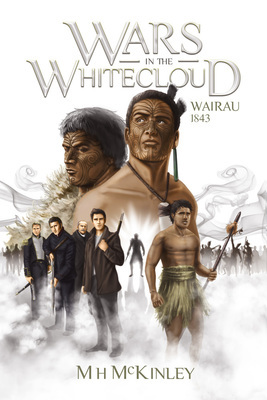
One of the things I love the most about the New Zealand Book Awards for Children and Young Adults is that it always introduces me to New Zealand books that I hadn’t heard of.  One of the gems that I’ve discovered from the shortlist is M.H. McKinley’s brilliant graphic novel, Wars in the Whitecloud: Wairau, 1843.

462476755

Wairau, 1843 is the first in the Wars in the Whitecloud graphic novel series that vividly brings to life important events in the early interactions between Maori and Pakeha.  This first book portrays the ill-fated meeting between early settlers and the Ngati-Toa tribe at Wairau in 1843.  It was a short but violent and bloody conflict and the author hasn’t shied away from portraying this.  M.H. McKinley stays true to these historic events while bringing to life both Maori and Pakeha figures who played a part in the conflict.  There are also extensive historical notes at the back of the book so that you can learn more about the events and the people involved.

As someone who loves both New Zealand history and graphic novels I absolutely love this book!  I loved studying New Zealand history when I was in high school and this is the sort of book that I needed.  Secondary school Social Science teachers all over New Zealand need to have this book put in their hands. It is an invaluable resource to make history come alive, not just for teenagers but adults as well.

The art is stunning throughout, with realistic depictions of Maori and Pakeha.  I especially like the art and layout of the front cover, which reminded me of a movie poster.  The only thing I didn’t like about the book was that there wasn’t enough of a margin throughout the book, meaning that you have to really pull the pages apart sometimes to read the text.

Wars in the Whitecloud: Wairau, 1843 is a finalist in the Best First Book Category of the New Zealand Book Awards for Children and Young Adults and it is certainly a winning book in my opinion.


2017 New Zealand Book Awards for Children and Young Adults Shortlist

logo_NZCYA

Congratulations to all of the authors and illustrators who are on the shortlist for the 2017 New Zealand Book Awards for Children and Young Adults, which was announced this morning.  As always there is a broad range of titles, some of which I’ve read and loved (Leonie Agnew’s The Impossible Boy) and others that I have yet to discover (Wars in the Whitecloud: Wairau, 1843).

I really like the addition of the Best First Book Award, which gives recognition to emerging writers and will hopefully encourage them to continue writing stories for children and young adults in New Zealand.  I think that it is a shame to lose the Children’s Choice Award but hopefully there will something else introduced to encourage young readers to engage with the finalist books.  I will certainly be encouraging the kids at my school to read the finalist books and we’ll do our own Children’s Choice Award in the library.

The finalists for the 2017 New Zealand Book Awards for Children and Young Adults are:

9241_Z

Picture Book Award

  • Fuzzy Doodle, Melinda Szymanik, illustrated by Donovan Bixley, Scholastic NZ
  • Gwendolyn! Juliette MacIver, illustrated by Terri Rose Baynton, HarperCollins Publishers (ABC)
  • My Grandpa is a Dinosaur, Richard Fairgray and Terry Jones, illustrated by Richard Fairgray, Penguin Random House (Puffin)
  • That’s Not a Hippopotamus! Juliette MacIver, illustrated by Sarah Davis, Gecko Press
  • The Singing Dolphin/Te Aihe i Waiata, Mere Whaanga, Scholastic NZ

9780143309062

Esther Glen Award for Junior Fiction

  • Helper and Helper, Joy Cowley, illustrated by Gavin Bishop, Gecko Press
  • My New Zealand Story: Bastion Point, Tania Roxborogh, Scholastic NZ
  • Sunken Forest, Des Hunt, Scholastic NZ
  • The Discombobulated Life of Summer Rain, Julie Lamb, Mākaro Press (Submarine)
  • The Impossible Boy, Leonie Agnew, Penguin Random House (Puffin)

shooting-stars

Copyright Licensing NZ Award for Young Adult Fiction

  • Coming Home to Roost, Mary-anne Scott, Penguin Random House (Longacre)
  • Kiwis at War 1916: Dig for victory, David Hair, Scholastic NZ
  • Like Nobody’s Watching, LJ Ritchie, Escalator Press
  • Shooting Stars, Brian Falkner, Scholastic NZ
  • The Severed Land, Maurice Gee, Penguin Random House (Penguin)

large_9781775433651

Elsie Locke Award for Non-Fiction

  • From Moa to Dinosaurs: Explore & discover ancient New Zealand, Gillian Candler, illustrated by Ned Barraud, Potton & Burton
  • Jack and Charlie: Boys of the bush, Josh James Marcotte and Jack Marcotte, Penguin Random House (Puffin)
  • The Cuckoo and the Warbler, Kennedy Warne, illustrated by Heather Hunt, Potton & Burton
  • The Genius of Bugs, Simon Pollard, Museum of New Zealand Te Papa Tongarewa (Te Papa Press)
  • Torty and the Soldier, Jennifer Beck, illustrated by Fifi Colston, Scholastic NZ

29065941

Russell Clark Award for Illustration

  • Fuzzy Doodle, illustrated by Donovan Bixley, written by Melinda Szymanik, Scholastic NZ
  • Gladys Goes to War, illustrated by Jenny Cooper, written by Glyn Harper, Penguin Random House (Puffin)
  • If I Was a Banana, illustrated by Kieran Rynhart, written by Alexandra Tylee, Gecko Press
  • Snark: Being a true history of the expedition that discovered the Snark and the Jabberwock . . . and its tragic aftermath, illustrated and written by David Elliot (after Lewis Carroll), Otago University Press
  • The Day the Costumes Stuck, illustrated and written by Toby Morris, Beatnik Publishing

CroppedImage256372-Ngarara-Huarua-E-med

Te Kura Pounamu Award for books written completely in te reo Māori

  • Ngā Manu Tukutuku e Whitu o Matariki, Calico McClintock, illustrated by Dominique Ford, translated by Ngaere Roberts, Scholastic NZ
  • Ngārara Huarau, Maxine Hemi, Illustrated by Andrew Burdan, Huia Publishers
    Te Haerenga Māia a Riripata i Te Araroa, Maris O’Rourke, illustrated by Claudia Pond Eyley, translated by Āni Wainui, David Ling Publishing (Duck Creek Press)
  • Te Kaihanga Māpere, Sacha Cotter, illustrated by Josh Morgan, translated by Kawata Teepa, Huia Publishers
  • Tuna rāua ko Hiriwa, Ripeka Takotowai Goddard, illustrated by Kimberly Andrews, Huia Publishers

SetSize300400-Awateas-Treasure-med
Best First Book Award

  • Awatea’s Treasure, Fraser Smith, Huia Publishers
  • Like Nobody’s Watching, LJ Ritchie, Escalator Press
  • The Discombobulation of Summer Rain, Julie Lamb, Mākaro Press (Submarine)
  • The Mouse and the Octopus, written and illustrated by Lisala Halapua, Talanoa Books
  • Wars in the Whitecloud: Wairau, 1843, written and illustrated by Matthew H McKinley, Kin Publishing

Grandad’s Guitar by Janine McVeagh and Fifi Colston

Sharing stories is an important part of our whakapapa. We share stories so that those who came before us are remembered and celebrated. Some of these stories lend themselves well to being made into a book that can be shared with people all over the world.  Janine McVeagh’s story of her husband and the connection that he made with their grandson through his guitar is one of these stories. In Grandad’s Guitar, Janine brings her family’s story to life with the help of Fifi Colston’s wonderful illustrations.

Grandads-guitar-front-cover-web

Kahu receives a battered, old guitar for his birthday. He would much rather have a shiny new one, but as his grandmother tells him the story of this guitar Kahu learns how to play the instrument and learns of his connection to his grandad. The guitar once belonged to his grandad who took it all over the world, along with his grandma. They traveled to England, France and Greece before coming home through Iran, Afghanistan and India. The guitar may look old and battered but it is quite a treasure that is now Kahu’s.

Grandad’s Guitar is a fantastic story that celebrates music and its power to connect people across countries and generations.  It shows the importance of sharing family stories to keep the memories of those who are no longer with us alive.  Janine’s storytelling makes you feel like you are a member of the family listening to her story.

I love the look and feel of this book. Makaro Press have done a wonderful job with the production of the book.  The paper is thick and the illustrations are glossy so you almost feel like you are holding Fifi’s original illustrations in your hands. Fifi’s illustrations take you back in time to the 60s, showing the fashion of the times and showing the different cultures through the food and clothing.  I especially love the music notes that flow through the illustrations.

This is a great book to share with children young and old. It’s an especially good book to use in a classroom because you could explore many different aspects of the story, from music and its ability to connect people, to family stories and how these are passed down the generations, or even looking at the different cultures that Kahu’s grandparents visit on their travels with the guitar.  With Matariki just around the corner I think this is the perfect book to share, as one of the things we celebrate at Matariki is our whakapapa.

Makaro Press have also created some wonderful teacher’s notes to go with the book too – http://www.makaropress.co.nz/wp-content/uploads/2014/05/Final-Teachers-Notes-Grandads-Guitar.pdf

Ruru’s Hangi by Nikki Slade Robinson

Nikki Slade Robinson’s award-winning picture book, The Little Kiwi’s Matariki, is my favourite book to read around Matariki.  In this book Nikki Slade Robinson introduced young children to Matariki through Kiwi and his friends in a simple yet fun way, using a mixture of English and te reo in the text.  In Nikki’s latest book, Ruru’s Hangi, she introduces young children to the concept of a hangi as the creatures celebrate the arrival of Ruru’s babies.

rurus-hangi-01

Ruru has been sitting on her eggs for 30 days and 30 nights and on day 31 the eggs wriggle and hatch.  Kiwi hears Ruru’s elated cries and goes to tell the other creatures in the forest.  Kiwi has an idea to celebrate the arrival of Ruru’s babies and gets the other creatures to help out.  They dig a hole and gather all of the things that they need to make a hangi.  When the hangi is ready they call Ruru and they share the kai together to celebrate.

Ruru’s Hangi is a perfect introduction to the hangi for young children and is another wonderful bilingual text from Nikki Slade Robinson that is great to share with young children, especially preschoolers.  Nikki introduces children to native birds and creatures, like the Tui, Katipo and Weka who all help to prepare the hangi. Nikki’s illustrations are fun with each of the creatures having a distinct personality.  The Te Reo used is basic and weaves effortlessly in with the English, so this is a great book to share even if you know very little Te Reo.  Nikki uses lots of repetition in the text, like:

‘Ka pai, perfect!’ they said. Shhh! Don’t tell Ruru!’

Nikki ends the book with a simple explanation of how to prepare a hangi, just like the creatures in the book have done.  Ruru’s Hangi is a invaluable resource for early childhood centres and schools.  It is a book that will be used by teachers and librarians around the country but also a book that children will love.  Anyone who is looking for a wonderful bilingual story to share with their children should get a copy of Ruru’s Hangi.

Lonesome When You Go Blog Tour – Interview with Saradha Koirala

Saradha Koirala is the author of the wonderful Lonesome When You Go, a YA novel that follows Paige and her high school rock band in the lead up to Rockfest.  To help spread the word about Saradha’s book, her publisher, Makaro Press has set up a blog tour.  I’m very pleased to be part of the Lonesome When You Go blog tour and today I get to share my interview that I did with Saradha about her book.  Thanks for joining me Saradha!

lonesome-cover-w-outline

  • What inspired you to write Lonesome When You Go?

I was on a train heading out to Johnsonville to see my brother and his oldest friend and just started thinking about when we all played in a band together in high school and what an excellent and tumultuous time that was in the midst of all the other dramas that those years can throw at you.

I wrote the briefest idea out on a scrap of paper there and then and talked to them about it when I arrived. We had a good old reminisce!

Our high school band’s rise and fall was pretty ordinary really and I wanted the story to be much more dramatic than that. It was a chance to revisit that time but I also ended up amalgamating a bunch of different high school experiences – as student and teacher – and a whole lot of rock and roll times, real and imagined. It seemed like a fun concept and it did turn out to be a lot of fun to write.

Being a high school teacher lent itself quite naturally to wanting to write for teenagers too, and I had an idea of what I thought some of the young women I’d been teaching might want to read about – a cool rock chick who isn’t fixated on a mysterious sparkly boy!

  • What are the songs that shaped teenage you?

I spent a lot of my early teen years listening to whatever I could find in the house, which was mostly popular tunes from the 60, 70s and 80s. It wasn’t until people started giving me mixed tapes and I could buy my own CDs that I really saw how music could change my views of self and shape my teenage identity.

Radiohead, Violent Femmes, Smashing Pumpkins, Dinosaur Jr, Stone Temple Pilots and Shihad were often on high rotation in my CD player. Music is much easier to access these days, but back then I really got to know the few albums I owned inside out! I would analyse the lyrics, read the liner notes, talk to my friends about them, sing along and all that.

I really think those bands of the mid-nineties tapped into a collective feeling that teenagers hadn’t been able to vocalise yet. They gave us permission to feel moody and outraged, while also acknowledging the sweetness we desired from the world. But it’s been a long time since I was a teenager, so maybe that’s Paige talking.

  • What genre of music best sums up your life?

Some days I would say it’s been a bittersweet folk album in the vein of Joni Mitchel’s Blue, but mostly I like to look at life as an Indie pop band full of cheesy catchy lyrics, bright colourful beats and frivolous synthesizers.

If Nobel Laureate Bob Dylan could write a soundtrack for the novel then everything in the world would make sense to me!

Actually I say that because I think he’s a master of creating story and character in very few words, but his music probably isn’t quite garage rock enough to capture the rock and roll aspect of the book.

So in that case, I’d say The Pixies. I kind of had The Pixies in the back of my mind as I described Vox Pop playing and I think they’re just an incredible band with a totally kick-ass bass player.

  • What is the most important lesson that you learned from being in a band?

Because I tend to be quite a self-sufficient person and my favourite things to do (writing and reading) are largely solo tasks, I think playing in bands taught me how to be part of something beyond myself. I never really played team sports, but was always in school orchestras, choirs, chamber music groups and, later on, rock bands.

In all those groups we had competitions to work towards, tours to organise, performances in front of sometimes many, but often very small audiences, rehearsals to get to on time and other band members to consider when making decisions and playing. It isn’t enough to just learn your part well and play it through, you really need to tap into what everyone else is doing and how they’re going, what they need and how what you’re doing affects all of that.

  • As well as being the author of Lonesome When You Go you’re also a poet.  Is the process of writing a novel similar to writing poetry for you?

They’re really very different processes for me and I’ve continued to do both simultaneously since finishing Lonesome. I enjoy being able to shift between the different forms.

When writing a novel I find I can set myself much more tangible goals – 1000 words a day, complete a particular scene etc. It’s a more continuous process too, as you’re developing and building on what you wrote last time and thinking about where you left your characters and what might happen to them next. With a novel there’s a lot of planning involved (for me, anyway) and behind the scenes stuff that helps inform my picture of the characters and their world.

I find poetry more difficult to describe in terms of a process as I’m less systematic about it. The poems come from everywhere and sometimes when I least expect them. I find I need to be open to poetry’s own schedule rather than try and force out a number of lines a day or give myself a deadline to complete something. Poetry doesn’t have to stay within a certain world or voice either, so there’s less need for continuity or meeting reader expectations.

The crafting process is probably similar for both. I think you need to be able to look at the world in a certain way to be a poet, and it’s a way of seeing the world that I really value.

Frankie Potts is back again!

Frankie Potts is the village of Tring’s number one girl detective.  She has flaming red hair, a questioning mind and an addiction to gobstoppers.  And she is REALLY good at solving mysteries. Frankie’s first two adventures saw her trying to solve a whole pile of mysteries including:

  • What’s my (sort of) new dog called, and where’s he from?
  • Why is my grandma acting so oddly?
  • Why are random pink items of clothing going missing all over the village?

Frankie Potts is back in two new adventures – Frankie Potts and the Postcard Puzzle and Frankie Potts and the Wicked Wolves.

9780143770206

Frankie’s list of mysteries to solve is getting longer by the day. Firstly, her mum is acting very strangely – she’s tired, grumpy and feels sick all the time. And then there’s Grandma M, who keeps dropping hints about expanding her troupe of performing greyhounds: Tinkerbell, Titania and Tiramisu.

With her detective sidekick Mac, Frankie travels to Giggleswick to find out about the mysterious Gideon R. Best, Animal Trainer Extraordinaire, and why he sent a postcard – with two kisses on it – to Frankie’s mum. How can Frankie work out what an overweight donkey, a cuddle-obsessed pig and a pooing parrot have to do with anything? And why has Tinkerbell started to waddle?

Kaboom! Things are getting explosive in Frankie’s family. She had better start solving.

9780143770459

A band of dancers with bells and blue painted faces have come to Tring, and Frankie can smell a mystery. Who are these Wicked Wolves? How come Grandma M knows them, and wants to pick a fight with them?

Meanwhile, Tinkerbell and Sparkplug’s seven adorable puppies are causing chaos at Frankie’s house. Grandma M is planning to give away four of them, and Frankie and Mac must make sure that they go to good homes. Ralph Peter-McGee, Frankie’s arch-enemy, seems to have his eye on her favourite pup Kettle Thomson. Can Frankie stop Kettle going to the wrong home? And why are those Wicked Wolves sniffing around the puppies?

The Inaugural Tring Talent Contest is rapidly approaching, and Frankie has some serious detecting to do. But maybe not all the clues are quite as they seem.

I can’t get enough of Frankie Potts!  She is a wonderful character that kids, especially girls, will love.  She is really inquisitive and mysteries seem to follow her wherever she goes.  Naturally she needs to solve them and you just know that she’ll find the answers.  She carries a notebook everywhere so she always has a list of mysteries that she needs to solve.  I like the way that these lists are included in the story so that the reader can try to solve the mysteries too.

One of my favourite features of the Frankie Potts series is the design of them.  Phoebe Morris’s illustrations and the bright colours make the covers stand out and look really appealing to the target audience.  I also really love the alliterated titles which sound really cool (Postcard Puzzle, Bikini Burglar).

Get the Frankie Potts series into the hands of any young fans of a good mystery.  I think they would be a good ‘next step’ for fans of Geronimo and Thea Stilton and Billie B. Brown.  Once you’ve read one you’ll be hooked!

Who Sank the Boat? and Other Stories by Pamela Allen

I love Pamela Allen’s stories.  My parents read them to me when I was young and now I read them to my daughter.  Her stories have stood the test of time and Pamela is still writing and illustrating new stories today.  Penguin Random House New Zealand have just released a beautifully packed collection of Pamela Allen’s stories just in time for Christmas.

9780143770329

Who Sank the Boat? and Other Stories is a hardback collection of just some of Pamela Allen’s best stories.  Inside you’ll find Who Sank the Boat?, My Cat Maisie, Belinda, Alexander’s Outing, Brown Bread and Honey, Daisy All-Sorts, Grandpa and Thomas, Cuthbert’s Babies and Share Said the Rooster.  There is also some information at the start of the book about Pamela Allen and the many awards that she has won throughout the years.

This is collection to curl up with and share with the young ones in your life.  It’s the perfect gift book to put under the Christmas tree and it is a book that will be shared again and again.  I will certainly enjoy re-living my memories of Pamela Allen’s stories with my daughter as we try to figure out who did sink the boat, how to get Belinda back and try to teach Billy and Ben to share.