Meet the Apocalypsies #4: Laurisa White Reyes

Today I’m joined by debut author and member of The Apocalypsies, Laurisa White Reyes.  Laurisa is the author of The Rock of Ivanore, book one in the new middle grade fantasy series The Celestine Chronicles, due out in May 2012. Laurisa lives in Southern California with her husband and five children. Publishing her first novel is a life-long dream come true.  Here’s the blurb for The Rock of Ivanore:

The annual Great Quest is about to be announced in Quendel, a task that will determine the future of Marcus and the other boys from the village who are coming of age. The wizard Zyll commands them to find the Rock of Ivanore, but he doesn’t tell them what the Rock is exactly or where it can be found. Marcus must reach deep within himself to develop new powers of magic and find the strength to survive the wild lands and fierce enemies he encounters as he searches for the illusive Rock. If he succeeds, he will live a life of honor; if he fails, he will live a life of menial labor in shame. With more twists and turns than a labyrinth, and a story in which nothing is at it seems, this tale of deception and discovery keeps readers in suspense until the end.

Now, it’s over to Laurisa to tell you about magic, impossible feats, and how The Rock of Ivanore came to be.  Thanks Laurisa for your wonderful post.

“Magic is believing in yourself. If you can do that, you can make anything happen.” – JohannWolfgang Von Goethe

I love magic. I am not ashamed to admit that I am a big fan of Harry Potter, Bartimaeus, and Eragon. As a kid, I devoured The Lord of the Rings by J.R.R. Tolkien and The Narnia Series by C.S. Lewis. I watched the Disney fairytales a hundred times over because for Cinderella, Sleeping Beauty, The Little Mermaid magic always saved the day.

Magic’s Long History

Magic has been around for as long as human kind has existed. Ancient civilizations such as the Greeks, Romans and Egyptians used rites and rituals to gain the favor of their Gods who in turn used their magical powers to intervene in human affairs.

During the late middle ages, people were often fascinated by magic, but they feared it, too. Joan of Arc (1412-1431) was accused of being a witch and burned at the stake. In 1692-1693 in Salem, Massachussetts, 200 people were accused of practicing magic, or what they called witchcraft. Twenty were executed.

Magic eventually became a form of entertainment. In the early twentieth century, Harry Houdini captured the world’s attention with his death-defying escapes and feats of magic. Today magic is as popular as ever with live stage shows, movies and television, and books attracting audiences all over the world.

Why We Love Magic

Why this ongoing fascination with magic? Could it be that deep down in the human psyche we long for the ability to change the world around us, to manipulate things to our liking? We want to defeat evil, to beat the odds, to overcome seemingly impossible challenges. Magic enables us to reach beyond the mundane and even negative aspects of our lives and to visualize what could be.

When Harry Potter, an otherwise average boy, destroys the ultimate evil villain Voldemort, we can imagine destroying whatever bad things are in our lives. When Eragon flies on his dragon across the mountains of Alagaesia, we are, in a sense, flying with him, achieving the impossible.

Magic is, of course, not real. As much as we love it, none of us will cast spells or tame dragons. But magic does allow us to dream and to discover ways to achieve the impossible that are within our means.

Reaching Beyond the Possible

On October 31, 2003 thirteen-year-old Bethany Hamilton was attacked by a 15 foot shark while surfing off the coast of Kauai in Hawaii. Bethany lost her left arm and, many believed, her future as a professional surfer. But Bethany did what seemed impossible: she taught herself to surf again with one arm and returned to the world of competitive surfing. Her story was made famous in a book and the recent film Soul Surfer.

Bethany’s courage and determination are not unusual. These are the very traits that have motivated individuals throughout history to achieve the impossible.

At the turn of the twentieth century, flying was nothing but a dream, something magical that had only been explored in fiction novels. Man could not fly. Everyone who had tried had failed. But Orville and Wilbur Wright dreamed big. They reached beyond human limitations and did the impossible. They flew.

How The Rock of Ivanore Came To Be
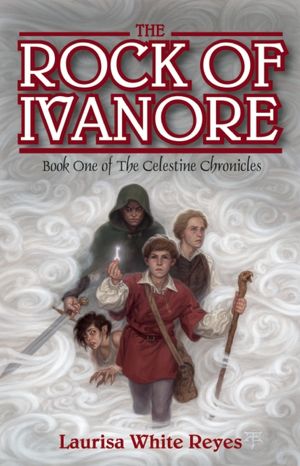
For me, writing and publishing my first novel was an act of achieving the impossible. Six years ago, my son and I often read stories together at bedtime. One night, he asked me to make up a story instead. I told him a story about Marcus, an enchanter’s apprentice who was a failure at magic. Every time he tried to cast a spell, it backfired. Each night, I’d ask my son what he wanted to hear about, be it dragons, or magic, or sword fighting, and I’d weave those elements into the story. Over the course of time, Marcus learned how to master his abilities to do what he never thought he could do before.

I have always wanted to be an author, but although I spent many years writing for newspapers and magazines, I thought I could never publish a book. Like Marcus, I was afraid that if I tried, I would fail. But telling those stories to my son gave me courage. I spent a year writing the first draft of The Rock of Ivanore. I received dozens of rejections and there were times I almost gave up.  But instead, I kept telling myself, “If someone else has done it, I can do it, too.” Eventually, Tanglewood Press offered me a contract and my dream of being a published author became real.

Aim High. Dream Big.

So what can magic do for you? It might propel you to climb Mount Everest or discover the cure to cancer or invent something that’s never existed before. It might motivate you to master a musical instrument, to paint a masterpiece, or win the next big football game. Or it might help you become the next New York Times bestselling author. Remember, magic is really nothing more than reaching beyond the possible to achieve the impossible. And in that case, there is at least a little magic in all of us.

Links:

My website  –  http://www.laurisawhitereyes.com

My blog – http://1000wrongs.blogspot.com

Joan of Arc – http://archive.joan-of-arc.org/joanofarc_short_biography.html

Bethany Hamilton – http://soulsurfer.com/

Harry Houdini – http://www.apl.org/history/houdini/biography.html

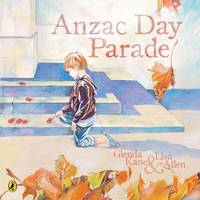
Guest Post: Glenda Kane on Anzac Day Parade

Today I’m joined by Glenda Kane, author of the picture book, Anzac Day Parade.  Glanda tells us about her Anzac memories and why she wrote her story.

My husband is Australian and I’m a Kiwi, so we’re Anzacs. Having travelled a lot, we realise we’re pretty lucky to live in this peaceful corner of the world.

We have three sons who love playing war games. To them, it’s fun. But I wanted them to understand that, in real life, war is not a game.

“There he stood on the sun-parched hill, a straggler from 18th Battalion.”

I’d attended an Anzac Day service at the Auckland Cenotaph with my family. Afterwards, I noticed an old man dressed in his best jacket – complete with medals – leaning on a walking stick, staring out towards Rangitoto. A small boy was looking at him with an expression of awe.

At that moment, I wondered what the old soldier was seeing as he gazed into the distance. What was he remembering? What had he been through? And what did the little boy think?

I’ll never know who they were. I just went away and made up the story.

“Did ya shoot them dead,” asked the bright-eyed boy. “Did it feel real cool to kill?” With a voice bereft of joy, he sighed: “No son, it was no thrill.”

When the illustrator, Lisa Allen, needed an old soldier to become her model, we contacted 92-year-old Crete veteran Noel Dromgool and his wife, Peggy. They allowed us to photograph Noel while he reminisced about training, battle, defeat, and his long internment in a prisoner of war camp.

We were privileged to hear his stories over the course of an afternoon. We left with immense respect for a man and his mates who sacrificed so much for their country and for future generations – us, and our children.

Quite a long time passed before the book was printed. Finally, I phoned Noel and Peggy to tell them it was published. There was no reply. Eventually I called another number listed under ‘Dromgool’ in the phone book. It turned out to be Noel’s son.

I explained who I was and said I wanted to show his father the new book. “Bad news, I’m afraid,” he said. “Dad died.” I wanted to cry. Instead, I asked if I could send the book to Peggy. “I’m afraid she died, too.”

The youngest soldiers from the Second World War are now at least 85 years old.

If anyone has a grandparent or great-uncle or neighbour who fought in the war, talk to them; ask them questions; write down their story. Do it now. There isn’t much time left.

I’m proud to say that when Noel’s son saw Anzac Day Parade he said he thought it was “pretty bloody good,” and that his dad would’ve thought so, too.

I hope young readers think it’s pretty good as well.

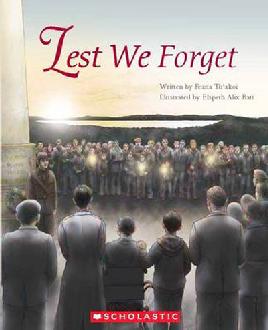
Guest Post: Feana Tu‘akoi on Lest We Forget

Today I’m joined by Feana Tu’akoi, author of the picture book, Lest We Forget.  Feana tells us about her Anzac memories and why she wrote her story.

When I was a kid, war horrified me. The terror, hardship and ruined lives – it seemed like such a stupid way to sort out our countries’ differences. I didn’t want any part of it. And I definitely didn’t want to celebrate it.

But I was a brownie and then a girl guide in small town South Canterbury. So, every year I had to march in the ANZAC parade.

I hated it – all those speeches, raving on about the brave soldiers who fought for victory. How could it be a victory when so many people died? What about the fathers, brothers and sons, on both sides, who never came back? What about the people who did come back, but were permanently damaged? I thought we should have been able to find a better way.

When my family moved to the North Island, I stopped going to the parades. But then I studied history at university. I talked to people who were involved in World War II and I realised that things weren’t as black and white as I’d thought.

Lots of people actually wanted to go to war, for lots of different reasons. They thought that they were protecting their families and helping to make the world a better place.

So my husband, Sione, and I went along to a Dawn Parade. I was shocked. Nobody talked about how glorious war was, or even that it was the right thing to do. They just talked about how important it was for us to remember, so that we could all continue to live in peace.

That was when I realised. We weren’t there to celebrate war. We were there, Lest We Forget. And that’s why I wrote this book. We need to remember the past, so we can make better decisions in the future.

I think that the next generation is smart enough to do just that. And that’s why I dedicated this book to my kids.

Feana Tu‘akoi, March 2012.

Guest Post: David Hill and Fifi Colston on The Red Poppy

This year there are a bumper crop of books about New Zealand’s involvement in war being published to coincide with Anzac Day on April 25.  The Red Poppy is one of them that really stands out for me because of it’s well-told story by David Hill and it’s stunning illustrations by Fifi Colston.  It’s a story full of tension, but ultimately about the friendship between enemies and the loyalty and bravery of one little dog.

I asked both David and Fifi if they would be able to tell me a little about their book and what it meant to them:

David Hill

The Red Poppy is a senior picture book which tells the story of a young soldier in a terrifying battle on the Western Front in France, during World War 1. Jim McLeod and his battalion have to attack across the open ground, into the face of artillery and machine-gun fire from the German trenches. With them goes the little black messenger dog, Nipper, whose job is to carry back requests for help, to save wounded men. As they charge across the open ground, past a place where red poppies grow among the shattered trees and buildings, Jim is hit by a bullet. He falls into a deep shell-hole, at the bottom of which lies a wounded German soldier. What happens between the two men, and the part played by Nipper in trying to save them, is the rest of the story.

I’ve dedicated my part in The Red Poppy to my uncles who fought in both World Wars. Their stories of the great battles and the courage of soldiers fascinated me from when I was a kid, and finally I had the chance to honour them in a story. Mud and huge guns and fear and the red poppies that have become the symbol of Anzac Day are all in this book.

Fifi Colston

My husband’s grandfather Rothwell, wrote postcards to his fiancé Hilda, from 1914-1918. Particularly poignant were two from France; they said simply “Am O.K” and “Keep smiling!” I was in the process of scanning and blogging these cards for the family (http://wartimepostcards.blogspot.co.nz/) when Scholastic asked me if I would look at a very special story to illustrate. I had decided some time ago that the next book I illustrated had to really mean something to me on a very personal level. Illustrating a book is a labour of love and I wanted to make a body of work that would enthrall me and push me to produce as excellent work as I could. For that I’d need to relate to the story; it had to move me. Then I read David’s manuscript. Jim’s letter home never mentioning the horrors of the trenches struck an immediate chord with me; those cheerful words from a young man, disguising the reality of his situation. Rothwell did come home from France to be a husband and father, but was far from ‘o.k’; dying just a few short years later from the cruel ravages of his war experience. Illustrating this book has been a journey through his time for me. I visited war museums, studied WW1 uniform, grew red poppies, photographed mud and rubbed chalk pastel until my fingers bled. I have learned much and my artwork is a tribute to him. It’s been a real pleasure working with David, Diana and Penny at Scholastic and Penny Newman the brilliant book designer who created the vision with me.


New Zealand at war: New books from Ken Catran

Ken Catran is one of New Zealand’s most prolific authors for children and young adults.  He’s an incredibly flexible writer because he writes for different age groups and in different genres.  One of my favourite books by Ken Catran is the New Zealand Post Children’s Book Awards 2011 finalist, Smiling Jack.  A lot of Ken’s books deal with war and the way that it affects those both at war and at home.

Ken has recently had two new books published which focus on New Zealand’s role in war. These two new books focus on two wars that most New Zealanders know very little about, the second Boer War (1899-1902) and the Malayan Emergency (1948-60).

When the Empire Calls – published by Scholastic New Zealand

It is 1899 and the Boer War has just begun in Africa. The Boer War is the first overseas conflict that New Zealand as a nation is involved in. Young men and women are eager to sign up to help the British Empire. Patriotism sweeps through New Zealand, even reaching small farming communities like Huia.

James McDonald is a teenage boy who lives on a farm in Huia with his parents and brothers and sisters. When his two older brothers sign up James is left to help his father run the farm. Left behind by his brothers and two sisters who are training to be nurses James has to assume extra responsibility and also grow up quickly. The reality of war is illustrated vividly by James’ brother Edward in his letters home and James begins to worry that he may never see his brothers alive again.

“Croaky Fred” who owns Fred’s Grocery Emporium is a person who believes that war is neither glorious nor justified. He challenges James to question his assumptions and ideas about the war. Fred’s outspoken views are considered unpatriotic by many townsfolk, who are unaware that Fred is himself a war hero who knows only too well the horrors of war. Unfortunately for James and his family, Fred’s concerns and dire predictions don’t turn out to be unfounded.

Earth Dragon, Fire Hare – published by HarperCollins New Zealand

New Zealand’s forgotten war, fought in the deep green jungles of Malaya. In 1948, Britain and her allies are pitted against Communist terrorists in a struggle for freedom. On opposing sides are Peter Hayes, a young Kiwi soldier, and Ng, a dedicated guerrilla. They are enemies but, as the bitter conflict deepens, both will ask questions. Who fights for freedom? Who is the oppressor?

And then a chance horoscope links them … to meet in battle. Destiny also decrees that Peter and Ng will become unlikely comrades. But in this treacherous and bloody war, nothing is as it seems – not even trust. The path to honour and the search for peace promise to be hard-fought and come at the highest cost. EARTH DRAGON, FIRE HARE is the ultimate tale of war.

Enter my Anzac books giveaway to win a copy of When Empire Calls and Earth Dragon, Fire Hare.

Win a Kyle Mewburn book pack

Kyle Mewburn is one of my favourite New Zealand authors.  He has an incredible imagination and writes some wonderful stories, for all ages.  Kyle’s latest picture books, Seesaw Po and Melu are among my favourite books at the moment.

Thanks to the wonderful people at Scholastic New Zealand I have a Kyle Mewburn book pack to give away, which includes a copy of Seesaw Po and Melu.  To get in the draw just tell me ‘What is your favourite Kyle Mewburn book?” and  enter your details below.  Open to NZ and Australia only.  Competition closes Wednesday 18 April.

Thanks to everyone for entering.  The winner is Rosie.

Picture Book Nook: Hugless Douglas and the Big Sleep by David Melling

I fell in love with Hugless Douglas from the moment I set eyes on this adorable bear.  He’s the bear that nobody wants to hug (apart from everyone who reads the book) and who ruins his wooly hat.  In his latest hilarious outing, Douglas has been invited to a sleepover at Rabbit’s house, but when Douglas is around, things don’t quite go as planned.

Douglas has been invited to a sleepover at Rabbit’s house so he packs his bag and makes his way through the forest.  Rabbit is happy to see everyone and invites them all inside, but however hard they push and pull, Douglas doesn’t fit.  Rabbit decides to dig a bigger hole and everyone squeezes inside for a bedtime story.  Everything is going fine until Little Sheep tickles Douglas’ nose and makes him sneeze.  Will anyone get any sleep?

Hugless Douglas and the Big Sleep is a perfect picture book that children and adults will love, whether at bedtime or any other time of the day.  David Melling is the king of picture books and I love both his wonderful words and his marvelous illustrations.  With his signature red scarf to his bumble bee pyjamas, Hugless Douglas is a cuddly, loveable character that deserves a place next to the Gruffalo, Spot, and the Very Hungry Caterpillar.  He’s full of enthusiasm and always ends up squashing a sheep or two.  However you’re feeling Hugless Douglas will cheer you up and make you laugh.  One of my favourite things in these books are the end pages featuring the sheep and rabbits.  In the other books they’ve modeled different hugs and hats, and in Hugless Douglas and the Big Sleep they model the different things you would take for a sleepover.  I hope there are many more Hugless Douglas books planned because I can’t get enough of this loveable bear.

5 out of 5 stars


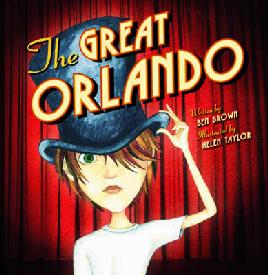
Picture Book Nook: The Great Orlando by Ben Brown and Helen Taylor

I’ve always loved Ben Brown and Helen Taylor’s books.  So far their books have been mostly about native New Zealand wildlife and they’re beautiful books.  Their latest book, The Great Orlando, is something completely different, but absolutely stunning.

From the very first page you know that this is not a happy story.  ‘The Great Orlando,’ otherwise known as Sunday Jones lives in a ‘rough, broken house with an unkempt lawn and a dead lemon tree in the front yard.’  His father is a cruel, miserable man, but his mother cares for him, protects him, and tells him bedtime stories of The Great Orlando.  When his mother dies, Sunday Jones is left with his father who makes his life a misery.  When he gets the chance to enter the school talent show, he transforms himself into The Great Orlando and is finally able to escape his miserable life.

The Great Orlando is a dark, multi-layered story about a boy who wants to escape.  Ben and Helen introduce us to Sunday Jones, a boy with a father who makes life hard for him, but holds onto the dreams his mother gave to him through her stories.   Ben Brown weaves his magic on the reader with his words and shows us a snapshot of Sunday’s life.  I particularly like the way Ben describes the mother’s love for her son.  This story also shows us how versatile Helen Taylor is.  It’s a completely different subject matter to her previous illustrations but they match the text perfectly and I really love them.  They’re quite dark and eerie, which matches the tone of the story, and I like the symbolism she’s used throughout the book (the shadow of the bull in the background and the butterfly).  The Great Orlando is the perfect picture book to share with older readers who will appreciate both the story and the illustrations.  I hope The Great Orlando sees some success outside of New Zealand for this talented duo.

4 out of 5 stars

2012 Carnegie and Kate Greenaway Medal Shortlist

The shortlist for the 2012 Carnegie and Kate Greenaway Medal have just been announced and they both include some amazing books.  I’d both love and hate to be a judge of these awards because I love the books they choose and would find it really hard to pick just one.

The Carnegie Medal is awarded annually to the writer of an outstanding book for children. This year’s shortlist includes:

The Kate Greenaway Medal is awarded annualy for distinguished illustration in a book for children.  This year’s shortlist includes:

  • Wolf Won’t Bite by Emily Gravett
  • Peter Puffin by Peter Horacek
  • A Monster Calls illustrated by Jim Kay
  • Slog’s Dad illustrated by Dave McKean
  • Soloman Crocodile by Catherine Rayner
  • The Gift illustrated by Rob Ryan
  • There Are NO Cats In This Book by Viviane Schwarz
  • Can We Save the Tiger illustrated by Vicky White

SO many great books!  I’ve read (and LOVE!) quite a few of them and will try and read the others before the winners are announced. 

Which ones are your favourites?

Win a Lorax prize pack

One of my favourite Dr. Seuss books is The Lorax so you can imagine how excited I was when I found out they were making a movie of the book (I love the movie of The Grinch and Cat in the Hat).  The movie is released in NZ next Thursday (29 March) and I have a Lorax prize pack to give away, including a copy of the eco-edition of the book, a Hoyts movie pass, and a recycled paper notebook.

Thanks to everyone who entered this competition.  The winner is Stephanie.