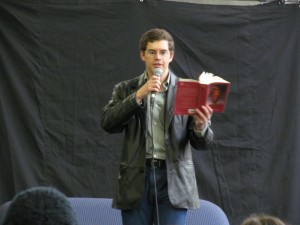
Christopher Paolini, the author of the Inheritance Cycle, came down to Christchurch at the weekend for the Armageddon Expo. Along with hundreds of other fans, I went along to listen to Christopher talk about his books and get some copies of his books signed. I caught up with Christopher to ask him a few questions about his books and writing.
- What inspired you to write the Inheritance Cycle?
Boredom, mainly, and the desire to have adventures myself. Growing up, I never wanted to be a writer. No, I wanted to be flying dragons and fighting monsters! But since I couldn’t do that, and since I had a lot of time on my hands after I graduated from high school at fifteen (I was homeschooled my whole life), I decided to write my daydreams down. Fortunately for me, enough people around the world have enjoyed reading them that I get to tell stories for a living.
- How do you keep track of all the different characters within the world of your books.
With lots and lots and lots of files. I didn’t used to do that when I started Eragon, but very quickly I found myself with so many characters, I couldn’t keep track of all of them in my head. So I started writing them down in a file, along with all of the words of my invented languages, timelines, and so on. It can be a bit tedious, but in the long run, it saves a lot of effort.
- How did it feel to get your story published when you were so young?
 Well, it was gratifying to know that people actually wanted to read something that I had written. And it was really neat to see my books shelved in the library and bookstores just like all of the books I had read growing up. But at the same time, it was a strange experience to go from a rather rural upbringing in Montana to traveling all around the world and talking to thousands of people at a time. Writing and publishing these books changed my life completely, and again, I’m grateful for the opportunities they have given me.
- The Inheritance Cycle has been a huge phenomenon. Do you feel any pressure from your fans to write something just as amazing, or even better, next?
Not really. I like to think that whatever I write next will be better than what I’ve written before (I’ve learned a lot from each book, after all), but either way, I’m happy with what I accomplished with the Inheritance cycle, and it won’t bother me if my future books aren’t as popular. When I started Eragon, I was just trying to write the sort of story that I wanted to read myself. Moving forward, that’s all I can hope to do. I can’t write to please others, only myself.
That said, I do think you’ll enjoy my next book. 🙂
- How did you find the experience of your book being made into a film?
Strange and surreal! I’m glad that the movie was made—very few books are ever adapted into films, after all—and I gave as much input as I could into the process, but ultimately, the movie reflects the director’s and the studio’s vision of the story, even as the books reflect mine. Hopefully we’ll get some more movies in the future, though.
- What books would you suggest for anyone that loves the Inheritance cycle?
Dune by Frank Herbert, Magician and sequels by Raymond E. Feist; A Wizard of Earthsea and the first two sequels by Ursula K. Le Guin; the Belgariad, the Mallorian, and the Elenium by David Eddings; Memory, Sorrow, and Thorn, by Tad Williams; the Gormenghast trilogy by Mervyn Peake; The Worm Ouroboros by E. R. Eddison; the Dragonriders of Pern series by Anne McCaffery; the Pit Dragon trilogy by Jane Yolen, the Redwall series by Brian Jacques; Fablehaven and sequels by Brandon Mull; and many, many more.
- Why did you want to be a writer?
Because I didn’t have anything else to do at the time, and because I’ve always enjoyed creating things with my hands, whether it was knives, swords, drawings, chain mail, or books. Also, because stories (both in books and in other media) touch me in a way that few things in this world do, and I wanted to share that feeling with other people.
- What’s the best thing and the worst thing about being a writer?
Worst thing? Having to sit down every day and work on the same thing for years on end, even if I don’t feel like it at that particular moment. Best thing? Getting paid to describe my dreams for a living, and knowing that what I’ve written has changed people’s lives all around the world.
- If you weren’t a writer what would you be?
A blacksmith, or a professional artist, or a film director. Whatever I ended up doing, I know that I would make things. That’s what I love to do—make things.
- If you could give one piece of advice to aspiring writers what would it be?
Hmm. There’s no way I can restrict it to one piece of advice, so here’s what I always tell aspiring writers, regardless of their age:
- Read, read, read, read. Good writers are good readers. Read what you love, but also read things outside of your comfort zone, because you’ll learn more than if you just stick with what you’re familiar with.
- Write every single day. Don’t wait for inspiration. I only get inspiration about once every three months. In the meantime, I write. I write on weekends, I write on holidays, and I write on my birthday. In short, I write. I do take Christmas off—and of course I can’t really write when I’m traveling—but that’s the extent of it. Writing is like playing a musical instrument: if you want to get good at it, then you have to practice every single day, even when you don’t feel like it. So unless you’re in the hospital—and maybe even then—you better write. Of all the traits an author can possess, persistence is the most important. It doesn’t matter how talented you are. If you don’t practice, you’ll never master your craft. As Calvin Coolidge said: “Nothing in this world can take the place of persistence. Talent will not; nothing is more common than unsuccessful people with talent. Genius will not; unrewarded genius is almost a proverb. Education will not; the world is full of educated derelicts. Persistence and determination alone are omnipotent. The slogan “press on” has solved and always will solve the problems of the human race”
- Write about whatever it is you care about the most. Writing is often difficult, but if you truly care about the subject material, that’ll help you through the rough patches. And it doesn’t matter what your interests are. Just don’t let someone else tell you what you should or shouldn’t write. If you want to compose a twelve-volume epic about singing toasters and flying unicorns … then go for it! There are over six billion people on this planet. Through sheer odds, I guarantee that there are lots of other people out there who like the same things you do, no matter how obscure they might be.
- Learn everything you can about the language you’re writing in. Grammar is boring, I know, but the better you understand your language, the better you’ll be able to get what’s in your head onto the page and into someone else’s head.
- Find someone in your life—friend, family member, teacher, librarian, etc.—someone who is a good reader, who likes the sort of thing you’re writing, and who can help edit your work. As painful as editing can be, I guarantee that you’ll learn more from editing than you ever will from just writing. The trick isn’t just to perform (and make no mistake, writing is a performance), the trick is to perform and to consciously evaluate what you’re doing so that you can improve. For example, when singing, it’s sometimes hard to hear if you’ve hit a bad note. That’s why every professional singer goes to a voice coach. Sometimes more than one. Writing is no different. Your trusted readers, your editors, are your voice coaches. Listen to them, and you’ll improve at your craft far faster than you would otherwise.
- This doesn’t work for every author, but I would also recommend plotting out your stories beforehand. Again, a musical analogy may serve: it’s hard to compose a piece of music while performing it, so first you compose it, and then you can concentrate upon performing it as beautifully as possible. So too with writing. Also, read the book Story by Robert McKee. It’s highly useful when it comes to learning how to understand the underlying structure of stories. If I try to write without knowing where the story is going, I get instant writer’s block.
- As a corollary to No. 2 – don’t give up. It’s incredibly easy to give up, and there are many, many people in the world who will tell you that you can’t do something. Well, I’m here to tell you that you can, assuming you’re reasonably intelligent and willing to put in the work. Sure, you’re going to get discouraged, and there are going to be days when it seems impossible to finish a book or get it published. That happens to all of us. Even once we’re published. The trick is to keep plugging away and trying to get better.
- And lastly, try to have fun. You don’t have to have fun every day, but try to have fun more days than you don’t. If you can’t, maybe it’s time to think of a profession in a different line of work.

Thank you for reading my books, and I hope you enjoy my future ones even more.
And as Eragon himself would say, “Sé onr sverdar sitja hvass!”
May your swords stay sharp.
 Garth P. Jones is the author of the creepy, gruesome and funny new book, Constable & Toop (you can read my review here). After finishing Constable & Toop I wanted to find out what else he had written and I discovered that we had his Dragon Detective Agency series and The Thornthwaite Inheritance sitting on our library shelves. I love his writing style and I now want to go and read all of his other books. Gareth very kindly answered my questions about his writing and his fantastic new book.
 I think mostly I was struck by how similar it was. I was interested in the South-East London suburbs where I live and where most of the action is based and, although there has been a lot of development, it’s not that different in terms of how connected to London you feel. One of the formative moments in writing was standing at the top of the hill between Honor Oak and Peckham Rye and looking down at London and I realised that the view probably wouldn’t have been dramatically different – give or take a few buildings here and there. There were lots of moments while wandering around London when I felt very connected with the city’s history.


 My Best Friends Are Books