Interview with Jonathan King

Jonathan King’s first graphic novel for children, The Inkberg Enigma, has just been released. It is a brilliant graphic novel filled with mystery, adventure and secrets. You can read my full review here on the blog.

I really love The Inkberg Enigma (it’s one of my favourite children’s graphic novels of 2020) so I wanted to ask Jonathan my burning questions about the story. Read on to find out about Jonathan’s inspirations for the story, the process of creating a graphic novel and some of the Easter Eggs you can find in the story.

Reading The Inkberg Enigma made me feel like I was 10 again, reading Tintin. Did you set out to create the kind of story that you would have loved as a kid?

Yes, I absolutely did. Tintin was huge for me as a kid: The Black Island was the first one I read, but I devoured them all over the years. I knew from the outset that I wanted it to be an adventure with fantastic elements. I think I decided fairly early that it wouldn’t be a globe-trotting kind of thing – that Tintin often did – but digging into the secrets and corners of one location. That’s what I love about stories – that can show us how our own world has hidden wonders.

The Inkberg Enigma is set in the fictional town of Aurora. Being a Christchurch local I immediately recognised Lyttelton in your illustrations. Did Lyttelton inspire the setting?

Lyttelton – and Diamond Harbour access the water – definitely the primary inspiration for the setting. I have family in Diamond Harbour and Lyttelton, and have spent quite a bit of time there. I love the self-contained nature of the two of them (in my story there’s no Christchurch just over the hill). And I’ve always had a connection to places by the sea – with their attached nautical influence, like Lyttelton has, of hotels, seamen’s union buildings, antique shops with diver’s helmets in the window (which I really did see in Lyttelton!). Other influences are Cannery Row in Monterey in California – where John Steinbeck set his book of that name — Astoria in Oregon (where The Goonies was filmed) and, for the castle, Larnach Castle in Dunedin.

I love that the main character in The Inkberg Enigma, Miro, sells off treasures from his attic to get money to buy books. Is this something you would have done as a kid?

I don’t know if I would go quite as far as Miro does! But I do remember what it felt like to be obsessed with things – like Star Wars figures or comics – and doing anything to complete collections. 

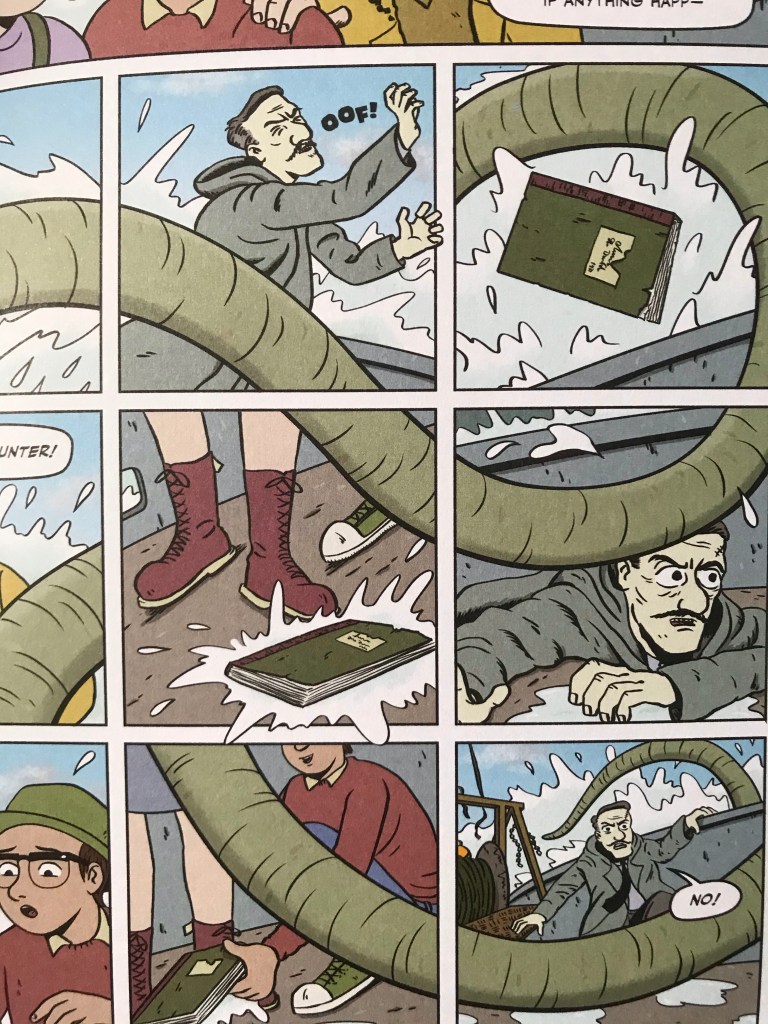
Mr Hunter is one of the creepiest characters in the story. I’ve been wondering where he got his huge scar from?

I think Mr Hunter has been involved in some very dangerous situations at sea over the years – but ignored or buried them, to continue the regime of (what they think is) control over the sea and the creatures below. I think there’s a climate change metaphor in there too …

The kids at my school often complain about how long it takes a creator to release a new graphic novel. To put it in to perspective for them can you explain the process of creating The Inkberg Enigma and how long it took you to pull the story together.

It takes a long time for new ones to come out because it takes a loooooong time to draw them! Unlike commercial monthly comics – which usually have a writer, a penciller, an inker, a colourist, a letterer – a graphic novel is usually the work of just one or two people. It took me about three years from start to finish. Part of that was finding the story. I had the world and the kids in the story pretty early … but the story they were in and the relationship between them took a while to find; I made a false start and pencilled / roughed about 40 pages … that I abandoned. But once I cracked the relationship between the kids, the stay was clear. Then I just had to draw it all. Certainly a detailed, clear line style slows things down. I’d love to try a looser (faster!!) style in the future.

Did you experiment much with the character designs before settling on their final look?

I think their look came quite quickly. Learning how to draw it consistently took a little while longer!

The name of the bookshop in the story is a nod to your film adaptation of Maurice Gee’s Under the Mountain that you wrote, directed and produced. Are there other Easter eggs for readers to look out for in The Inkberg Enigma?

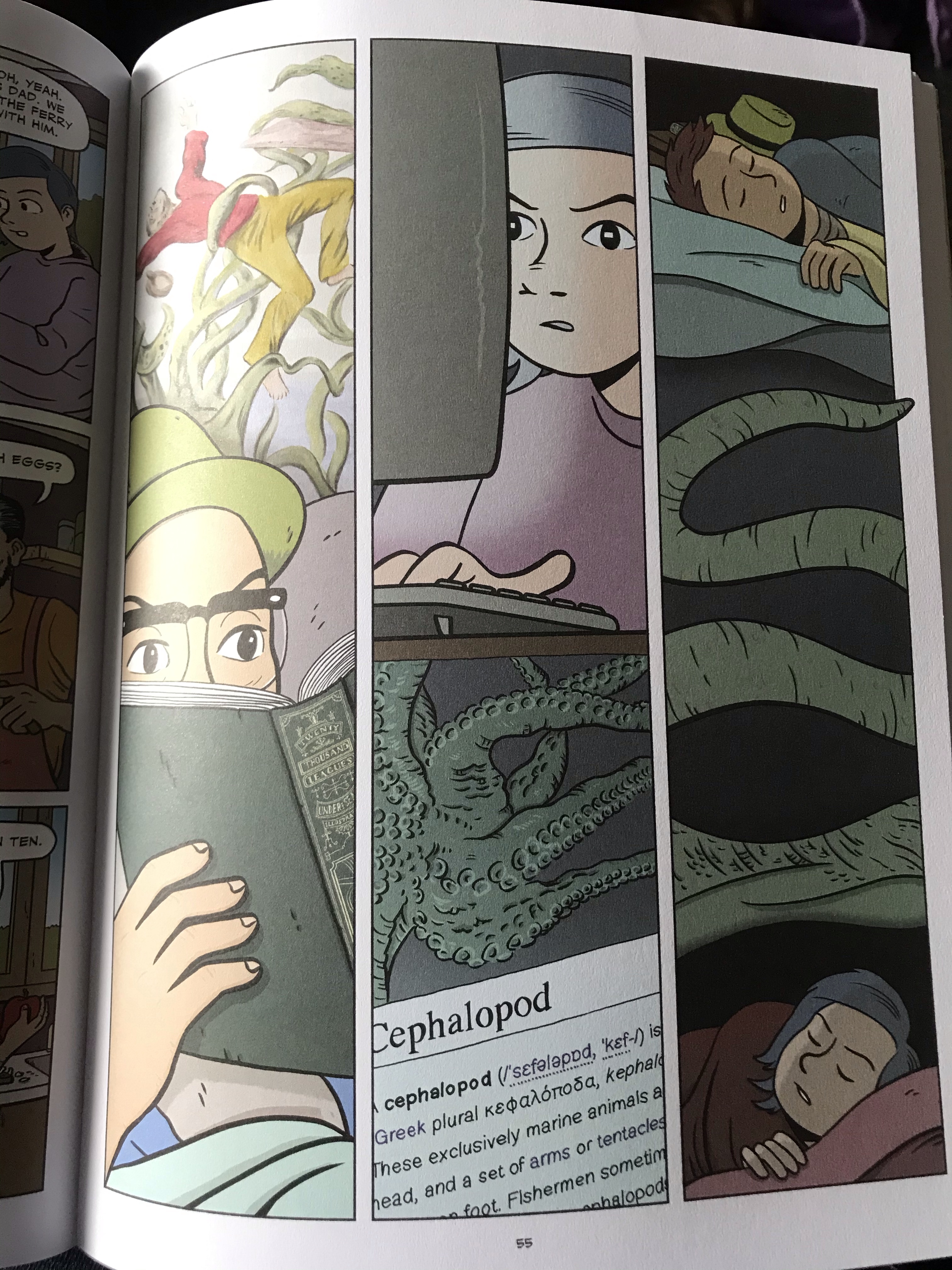
I’m thrilled you spotted that. Yes, there are others: a number of Tintin props, I think. The books in the bookshop Miro looks at are favourites of mine. The museum building is based on the jailhouse in Goonies (a real building in Astoria!) I’m sure there’s other odds and ends!

How does your film background influence your comics?

I’m not sure. Probably it does n terms of story structure – something I’ve spent a long time thinking about. I probably think it terms of close ups and wide shots … and even the ‘lens’ that I frame images in: a wide angle lens sees something differently from a ‘long’ lens. Certainly telling the story with pictures is as important as words. 

Would you like to make a movie of The Inkberg Enigma?

All the way through making I didn’t think that I did: it was only ever meant to be a comic. Now that it’s finished, it’s its own thing … yeah, I kinda would actually! 🙂 

There are so few comics and graphic novels published in NZ for kids and teens, even though these books are some of the most popular with kids in our libraries. Do you have plans to write more for this age group?

I’m sure one of the reasons that there are so few is that for something takes so long, it’s really hard to get enough income to justify the time it takes (though I must acknowledge the support I ad from Creative NZ). Some cool local creators are Katie O’Neill’s Tea Dragon Society books, Ant Sang’s Helen and the Go-Go Ninjas, Roger Langridge’s Abigail & The Snowman and, of course, bob Kerr and Stephen Ballantyne’s Terry Teo books. 
I would love to write more for this age group. Having done a book that took years to draw, I’d love to write book that’s just words – a mystery perhaps! And, yes, before long I’ll do another graphic novel. 

Check out my review of Jonathan’s graphic novel, The Inkberg Enigma. Available now from Gecko Press.

The Inkberg Enigma by Jonathan King

The Inkberg Enigma is a brilliant graphic novel from New Zealand comic creator and film maker, Jonathan King. Reading this made me feel like I was 10 years old again, devouring Tintin and wanting to be him.

Miro is a book-obsessed boy living an adventurous life through the stories of Jules Verne and Edgar Rice Burroughs. Real-life adventure finds him though when Zia, a girl from his school, drags him in to a town mystery. Miro is reluctant to get involved but, as Mira says, ‘this is how you have adventures. You find cool things and you do them…you don’t just read books about them!’ Their town of Aurora has been built on the prosperous fishing in their harbour. When Miro and Zia see something that they are not supposed to, they set out to discover the truth behind the legacy of Aurora and the shady characters who run the town.

The Inkberg Enigma is filled with adventure, mystery, and secrets. It’s also just the right amount of spooky and sinister that keeps you turning the pages. I flew through the story the first time and have since read it again to fully appreciate the story and the artwork.

I love all the characters, from the book-loving Miro and the ever-curious Zia to the sinister mayor of Aurora, Mr Hunter. Miro reminds me a lot of myself because he sells artefacts that he finds in his attic just so he can buy more books. His habit gets so bad that he has a whole spare room full of books! He’d also rather read about adventures than have them in real life.

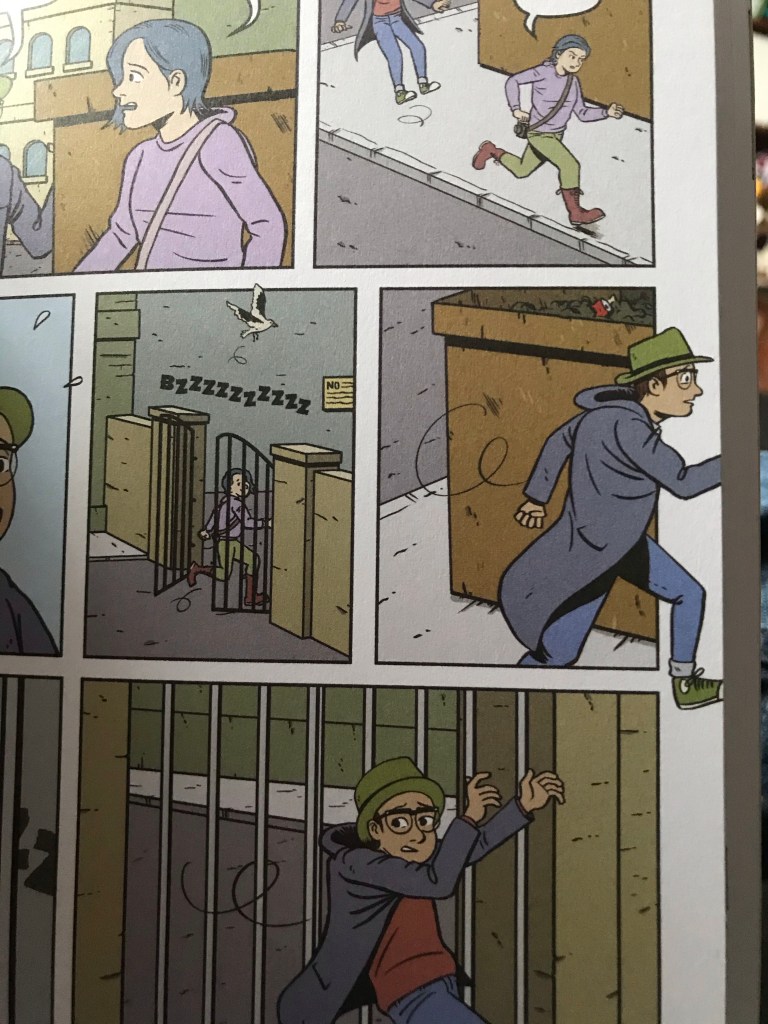
Jonathan’s illustrations are fantastic, from his characters to the images of the town of Aurora. As a Christchurch local I immediately recognised Lyttelton as Aurora, from the town streets to the museum and the harbour. I really like the flow of the illustrations, with the scene on the boat being my favourite. Jonathan doesn’t let the panels limit the story either, with some really clever sections where the illustrations move out of the panels.

The Inkberg Enigma is one of my favourite kids graphic novels of 2020 and I’ll be recommending it to everyone. I really hope there will be more stories with Miro and Zia.

The Inkberg Enigma is released in August from the wonderful Gecko Press. Stay tuned for my interview with Jonathan King.

#Tumeke! by Michael Petherick

2020 New Zealand Book Awards for Children and Young Adults Junior Fiction Finalist

Plans for the Newtoun community’s Waitangi Day celebrations are well under way: Monty and Pete `The Deadly Icedagger’ plan a wrestling demo. Dreadflock needs to upskill her braiding technique. Constable Rutene is planning the biggest kapa haka event in suburban memory. Sauerkraut Burgers are gearing up for fierce battle with Carnivores Rule. And that’s not the half of it.

Flicking through Tumeke originally I didn’t think I would like it but after reading it in one sitting I completely loved it! It’s totally unique and has a real Kiwi flavour to it. The story is pieced together from notices on the community noticeboard at the library, text messages, emails, diary entries, social media posts and more. The design is so clever and visually appealing. I loved all the different personalities, from the local constable and his relationship with the teacher to the local Lord of the Rings and Beatles Appreciation Society and the owner of the goat who keeps causing havoc (and communicates using emojis).

I think, because of Tumeke’s uniqueness this will be the winner of the Junior Fiction category of the 2020 NZ Book Awards for Children and Young Adults.

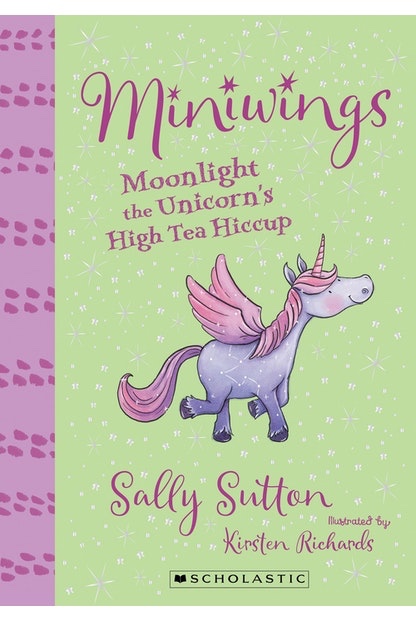
Moonlight the Unicorn’s High Tea Hiccup by Sally Sutton and Kirsten Richards

2020 New Zealand Book Awards for Children and Young Adults Junior Fiction Finalist

The Miniwings books are totally FABO! I’ve loved all of the books in the Miniwings series but Moonlight the Unicorn’s High Tea Hiccup is one of the best. Moonlight is the Miniwing who loves food and there are plenty of tasty treats on offer when Sofia and Clara are invited to a high tea with their great-aunts. Where the Miniwings go trouble follows and their mischief is super messy in this story.

As a librarian I love these books because they’re so perfect for young readers and as a parent I have loved reading them to my 5 year old. Sally Sutton has created a special language, Miniwingese, which makes the stories really fun to read and makes you laugh out loud. Each of the Miniwings have their own unique personality so it’s fun to make up different voices for them. They also really like to sing so there are songs throughout the story. Part of the appeal of these books is that they’re packed with colour illustrations. Kirsten Richards’ illustrations bring the cheeky Miniwings to life and she must have really enjoyed creating the mess in this book.

I love this series and I was excited to see that there is another book coming soon.

Interview with CATs hero Claude D’Bonair

Award-winning author and illustrator, Donovan Bixley, is currently chronicling the heroic adventures of the famous CATs pilot, Claude D’Bonair.  Donovan very kindly put me in touch with Claude, who took some time out from fighting the dastardly DOGZ to answer my questions.

  • We’ve heard the tales of your daring missions so far.  What are the three most important things to take with you on a mission?
Phew Zac, you had to start with a hard question. Let me think … well, the truth is that we never know where the next mission will take us, or what danger we’ll be heading in to. You can’t rely on anything. You might find yourself deep in enemy territory without your squadron. You might even lose your plane … which happens to me more often than I’d like to admit! Quick thinking and fearlessness has helped me get out all sorts of dangerous situations. So, I guess the best thing I can take on a mission is my courage and inventiveness … that, and a packet of cat biscuits.
  • How do you prepare before going off on a mission?
You’re asking the wrong cat. I’m not much for preparing. I just try and figure out what to do as I go along. My friend, Syd – he’s actually more like an uncle to me – he likes to “prepare” for a mission by eating and sleeping. Syd says, “In war, you never know when you’ll get you’re next meal”… that doesn’t explain why he used to eat and sleep all the time before the war too!
For me, a change is as good as a rest. I like to clear my mind, practicing Meowzaki, the martial art I learnt from my dad.
  • C-for is the cat responsible for the brilliant inventions that help you on your missions. What is your favourite of C-for’s inventions?
It would have to be his exploding fake dog poop.
  • You get in to some pretty hairy situations on your missions.  Who is the best cat to have by your side when catastrophe strikes?
When catastrophe strikes, it usually means you’ve downed your plane behind enemy lines. In those situations you want someone who doesn’t just follow orders. You want someone who speaks their mind and thinks on their feet. I think I’d want to have Manx at my side when I’m in a tight jam. Manx and I just got back from a dangerous mission in Venice and really she saved my tail that time. Manx is a top engineer and real problem solver in tricky situations.
  • Your dad was a race car driver, adventurer and pilot and you certainly seem to have inherited his bravery.  What was one of the most important lessons that you learnt from him?
Ha ha, that makes me think of a time when I was young, when dad and Syd took me on one of their crazy adventures to Japan. Syd is always suspicious of new things – but this one time, he thought wasabi paste was a lip cream – ha ha – after that, he wouldn’t eat Japanese food for the rest of the trip.
My dad was completely different. He was never afraid to try new experiences. It can be scary at first, especially when you’re in a new place and you don’t speak their language, but you soon find that they are just like you. Whether someone was cat or dog, ginger striped, or black and white spotted, my dad always treated others they way he wanted to be treated. So I guess he left me with two great lessons: to be fair and to be fearless. I owe my life to those lessons, and even though CATs are at war with the DOGZ army, I’ve often made friends with dogs who’ve helped me when I’ve been in greatest need.
  • What do you like to do when you’re not off foiling the DOGZ plans?
You know, I’m not one of those cats who like to lounge around sleeping all day (unlike some cats I could name). I love to get out and see the world and try new things. One day, when cats and dogs are living in peace again, I want to take off and see some of the friends I’ve made around the world. That will make for some exciting adventures.
Claude

Ruru’s Hangi by Nikki Slade Robinson

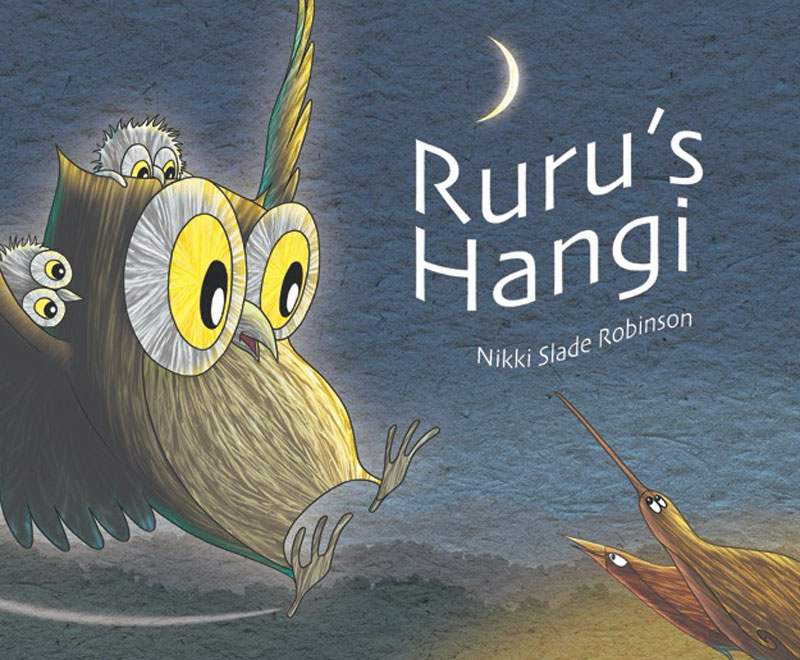
Nikki Slade Robinson’s award-winning picture book, The Little Kiwi’s Matariki, is my favourite book to read around Matariki.  In this book Nikki Slade Robinson introduced young children to Matariki through Kiwi and his friends in a simple yet fun way, using a mixture of English and te reo in the text.  In Nikki’s latest book, Ruru’s Hangi, she introduces young children to the concept of a hangi as the creatures celebrate the arrival of Ruru’s babies.

rurus-hangi-01

Ruru has been sitting on her eggs for 30 days and 30 nights and on day 31 the eggs wriggle and hatch.  Kiwi hears Ruru’s elated cries and goes to tell the other creatures in the forest.  Kiwi has an idea to celebrate the arrival of Ruru’s babies and gets the other creatures to help out.  They dig a hole and gather all of the things that they need to make a hangi.  When the hangi is ready they call Ruru and they share the kai together to celebrate.

Ruru’s Hangi is a perfect introduction to the hangi for young children and is another wonderful bilingual text from Nikki Slade Robinson that is great to share with young children, especially preschoolers.  Nikki introduces children to native birds and creatures, like the Tui, Katipo and Weka who all help to prepare the hangi. Nikki’s illustrations are fun with each of the creatures having a distinct personality.  The Te Reo used is basic and weaves effortlessly in with the English, so this is a great book to share even if you know very little Te Reo.  Nikki uses lots of repetition in the text, like:

‘Ka pai, perfect!’ they said. Shhh! Don’t tell Ruru!’

Nikki ends the book with a simple explanation of how to prepare a hangi, just like the creatures in the book have done.  Ruru’s Hangi is a invaluable resource for early childhood centres and schools.  It is a book that will be used by teachers and librarians around the country but also a book that children will love.  Anyone who is looking for a wonderful bilingual story to share with their children should get a copy of Ruru’s Hangi.

Winners of the 2016 New Zealand Book Awards for Children and Young Adults

logo_NZCYA

The winners of the 2016 New Zealand Book Awards for Children and Young Adults were announced last night in Wellington.  Congratulations to all the winners and those who were chosen as finalists in the awards.  Congratulations also to the judges of this year’s awards who had the tough job of choosing the winners from all the fantastic books that were submitted.  It’s a tough job but someone’s got to do it.  I personally think they made some great choices for the winners.  Kids also made some fantastic choices too in the Children’s Choice Awards.

Here are the winners of the 2016 New Book Awards for Children and Young Adults:

Anzac 2

  • Margaret Mahy Book of the Year and winner of the Elsie Locke Award for Non-Fiction

ANZAC Heroes by Maria Gill, illustrated by Marco Ivancic; Scholastic New Zealand

  • Best First Book Award

Allis the little tractor by Sophie Siers, illustrated by Helen Kerridge; Millwood-Heritage Productions

  • Te Kura Pounamu Award for the best book in te reo Māori

Whiti te rā! by Patricia Grace, translated by Kawata Teepa, illustrated by Andrew Burdan; Huia Publishers

  • Picture Book Award

The Little Kiwi’s Matariki written and illustrated by Nikki Slade Robinson; David Ling Publishing (Duck Creek Press)

  • Esther Glen Award for Junior Fiction

From the Cutting Room of Barney Kettle by Kate De Goldi; Penguin Random House (Longacre)

  • Young Adult Fiction Award

Battlesaurus: Rampage at Waterloo by Brian Falkner; Pan Macmillan Australia (Farrar Straus Giroux)

  • Russell Clark Award for Illustration

Much Ado About Shakespeare illustrated by Donovan Bixley; Upstart Press

New Zealand children enthusiastically voted for their own specially selected finalists’ list for this year’s HELL Children’s Choice Awards. Each book wins $1,000. The winners are:

  • Te reo Māori

Te Hua Tuatahi a Kuwi written and illustrated by Kat Merewether, and translated by Pānia Papa; Illustrated Publishing

  • Picture Book

The House on the Hill by Kyle Mewburn, illustrated by Sarah Davis; Scholastic New Zealand

  • Junior Fiction

The Girl Who Rode the Wind by Stacy Gregg; Harper Collins

  • Non-Fiction

First to the Top by David Hill, illustrated by Phoebe Morris; Penguin Random House (Puffin)

  • Young Adult Fiction

Stray by Rachael Craw; Walker Books

You can read the full media release here, including the thoughts of the judges on each of the winning books.  You can download the Winners Poster here.

Win a copy of Fuzzy Doodle

Fuzzy Doodle is the stunning new collaboration between the very talented Melinda Szymanik and Donovan Bixley.  Fuzzy Doodle will be a favourite with young and old alike and I think everyone needs to own a copy of this wonderful book.  You can read my review here on the blog.

9241_Z

Thanks to the lovely people at Scholastic NZ I have a copy of Fuzzy Doodle to give away.  All you have to do to get in the draw is email bestfriendsrbooks@gmail.com, with the subject ‘Fuzzy Doodle,’ along with your name and address.

Thanks to everyone who entered.  The winner is Craig.


Flying Furballs: Dogfight by Donovan Bixley

Donovan Bixley is one of our most talented illustrators in New Zealand and I’d have to say he’s my favourite illustrator.  Not only has Donovan illustrated stories for other wonderful authors like Kyle Mewburn, Yvonne Morrison and Margaret Mahy, he has also written and illustrated his own books.  His style is unique but it varies slightly depending on the topic, with a particular talent for poo, vomit and snot.  Donovan has recently released a new series, called Flying Furballs, that he has both written and illustrated.  The first book in the series, Dogfight, really proves why Donovan is one of our most talented creators of great books for kids.

FurballsDogfight-722x1024

Strap on your flying goggles, prepare your bi-plane and get set to join Claude D’Bonair and the CATs Air Corps for adventure, crazy missions, dangerous rescues and plenty of laughs.  Donovan Bixley shows us the Great War like we’ve never seen it before.  It’s the CATs (Cat Allied Troops) versus the DOGZ (Dog Obedience Governed Zone) as the CATs try to stop the DOGZ from taking over Europe.  It’s up to Claude and the team at CATs HQ to fight for all of katdom.  In this first book Claude decides to take matters into his own hands when the CATs most famous dogfighter, Major Tom, is captured and held in the DOGZ castle headquarters.  It’s up to Claude to rescue Major Tom and bring him home.

Dogfight is a witty and very funny start to the Flying Furballs series.  Donovan really knows his audience and tells a story that kids will love.  Donovan’s trademark humour shines through in both the illustration and the text.  There are cat and dog puns galore dotted throughout the story.  At one point in the story when Claude meets Major Tom he says that he was afraid that the DOGZ were torturing him and Major Tom’s reply is:

‘Oh yes, got plenty of that.  They pulled my tail. Rubbed my fur the wrong way.  Dunked me in a bathtub.  And the mongrels dangled a piece of wool in front of me, just out of reach  – for a week!’

Even the characters names are hilarious, from Syd Fishus, the cat who flew with Claude’s father, to Commander Katerina Snookums, and C-for, the CATs resident inventor.

Like the Dinosaur Rescue series and Dragon Knight series Donovan has included some cool diagrams in Dogfight.  These explain how gadgets and planes work and show the different important parts.

Dogfight will have you laughing out loud and desperately wanting to get hold of the next book in the series.

The Little Kiwi’s Matariki by Nikki Slade Robinson

Matariki books for children are always in high demand.  There are only a couple that are suitable for introducing Matariki to preschoolers, while also being a fun story.  Nikki Slade Robinson has just released a wonderful new Matariki book, The Little Kiwi’s Matariki, that is perfect for sharing with our young tamariki.

little-kiwis-matariki-01

In The Little Kiwi’s Matariki, Kiwi wakes up to the moon shining deep into her burrow.  She knows that something is different from other nights and sets off to tell everyone that ‘its coming.’  All of the other creatures tell Kiwi ‘Kao. No, no little Kiwi,’ it’s their tummy rumbling or their singing in their dreams.  They all follow Kiwi though, and when they get to the sea shore they see the light is coming from Matariki.  The book ends with a simple explanation of Matariki that is perfectly aimed at young tamariki.

The Little Kiwi’s Matariki is my new favourite Matariki book.  It’s perfect for introducing our young tamariki to Matariki in a fun way.  It is an ideal book for parents, teachers and librarians who want to share a bilingual book with their tamariki.  Nikki has included some basic te reo, alongside the English equivalent, which is great for those who aren’t confident speakers of te reo. Nikki has also used repeated refrains, like ‘Kao. No, no little Kiwi,’ that tamariki can join in with.

The illustrations are also very appealing to tamariki.  As well as Kiwi, there are lots of other native birds and a spider that tamariki will be familiar with, including Tūī , Ruru and Katipo.  Nikki has given each of them a distinct personality.  I especially love the Ruru’s huge eyes.  One of the other things I love about Nikki’s illustrations is the way that the moon and the stars of Matariki glow on the page.

My favourite aspect of Nikki’s book is the way that the different characters are used to highlight the different aspects of Matariki celebrations.  Tūī, for example, says ‘Matariki? Time for music and dance!’ This fits with Tūī’s personality, so you know that a lot of thought has gone into choosing the right creatures for the story.

If you only buy one Matariki book for your home, school or centre this year make it The Little Kiwi’s Matariki.