Reading Matters 2013 – Highlights #8

IMG_0304

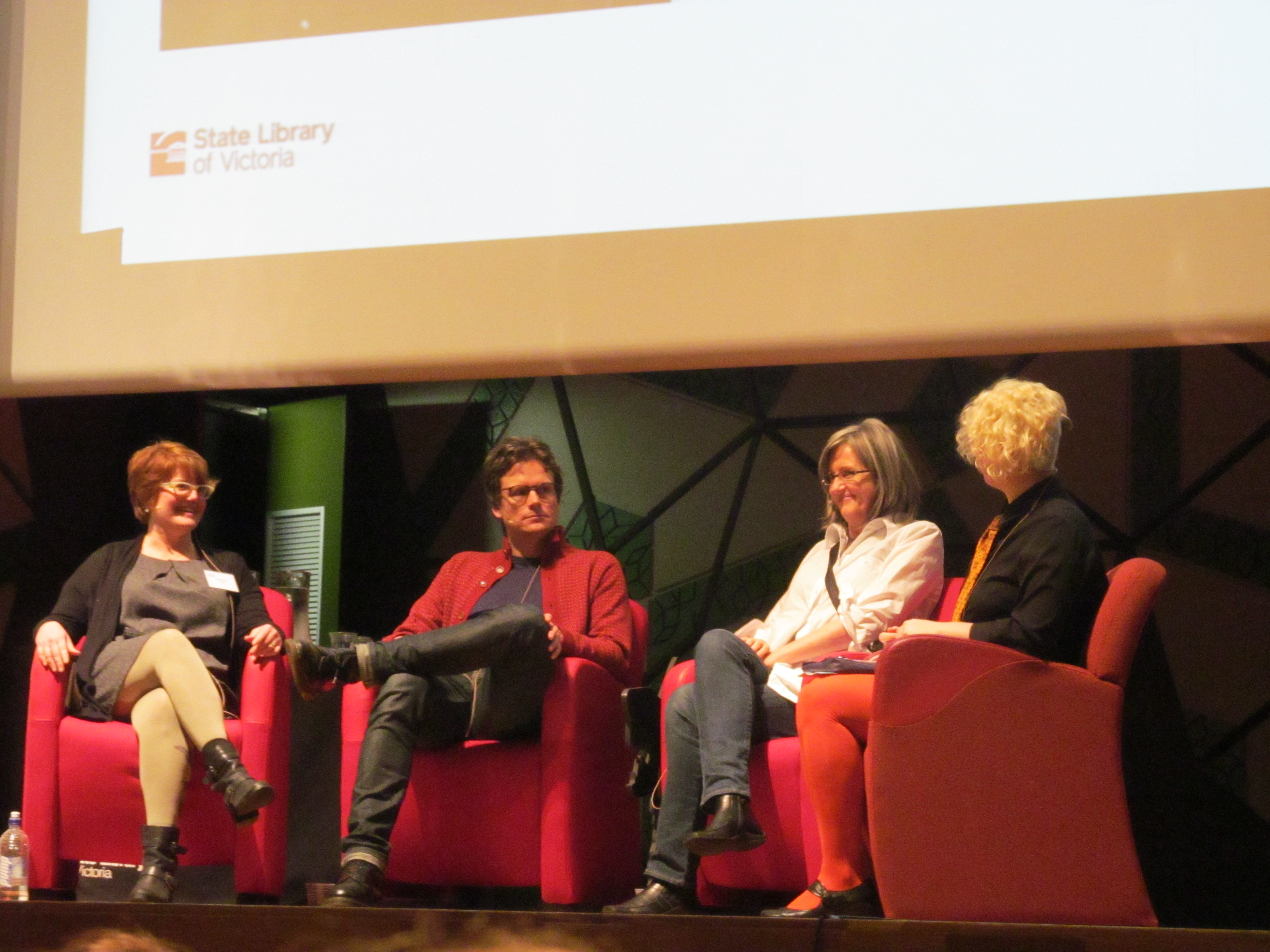
Outsider, outside – Garth Nix, Tim Sinclair and Vikki Wakefield navigate the outside perimeters

Garth Nix thinks that all of his characters are outsiders in one way or another, but ‘you can be an insider/outsider, depending on context.’  Vikki says that her characters are exploring their own worlds from the inside, ‘she’s not outside – it’s her story, she lives there.’  She believes that books are open to our own ideals.

‘We’re attracted to flaws because we know we’re not perfect. It’s a nice feeling to open a book and see someone more screwed up than us.’

Garth says that the attraction of outsiders is that ‘everyone feels like an outsider in some way.’ He also points out that you ‘can be an outsider for three minutes and it can affect you.’  Vikki found her Welsh roots and discovered that finding out ‘something that happened centuries ago to your family, affects how you see yourself.  Suddenly my life seemed bigger.’  For Vikki, it was a moment of reckoning with a snake in her house and The Drover’s Wife that influenced Friday Brown.

Vikki says that she writes for teens like her who didn’t have books as a kid and didn’t have parents who were readers. When Vikki found books ‘the world was bigger.’ Vikki mentioned that she was surprised by the readers of her books.  She told the story of a teenage boy who loved Friday Brown and how she was surprised by this.  Vikki was also surprised when her books were shortlisted for prizes, as she never imagined they would be.  She believes that it’s important though that ‘age and sex do not define a reader.’

Reading Matters 2013 – Highlights #7

IMG_0299

Gender less – Myke Bartlett, Libba Bray and Fiona Wood unbox identity

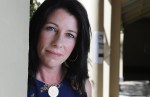
This was the session that stuck with me the most.  Each of the authors had very valid points of view and it was really interesting.  The topic of ‘girl book’ vs ‘boy book’ bothers Libba Bray.  There’s the connotation that if it’s a ‘girl book’ that boys don’t need to be concerned about the female experience, and if it’s a ‘boy book’ that girls don’t need to understand males.  Libba suggested that ‘if story is about connection and pushing down barricades, why would we want to limit that?’  She asks teens to question the status-quot and think for themselves.

Myke says that he set out to ‘write a book that includes a strong female, but I didn’t think that would exclude male readers.’ He wanted to write a character that was more realistic, with inner strength.  He would like to write a book with a male character to explore what it’s like to be a male (I’m going to keep harassing Myke about this because I want to read this story).

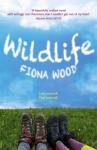
When the authors discussed book covers, Myke suggested that the cover for Fire in the Sea was probably telling boys that it’s OK to read, even though it has a female main character.  Libba Bray hyperventilated over the cover for Beauty Queens, but calmed down when she appreciated that it was mocking the headless female cover trend.  Fiona Wood wanted gender-neutral covers for her books, Six Impossible Things and Wildlife.  The idea behind her Wildlife cover was ‘the selfie.’  Fiona suggested that publishers need to come up with covers that ‘present an inclusive normality.’

A quote from Libba Bray sums this session up perfectly – ‘readers need the full ROY G BIV of emotional experience. We’re stuck on what boys want and what girls want. We just want good stories.’


Reading Matters 2013 – Highlights #6

What’s yours is mine – Alison Croggon, Andrew McGahan and Gabrielle Williams explore creation through adaptation

Hopefully you can forgive me for two things with this session – I forgot to take photos and was so interested in hearing what Gabrielle Williams had to say that I didn’t take notes about Alison and Andrew. For a more detailed account of this session you should definitely check out Danielle Binks’ report on her blog, www.alphareader.blogspot.co.nz.

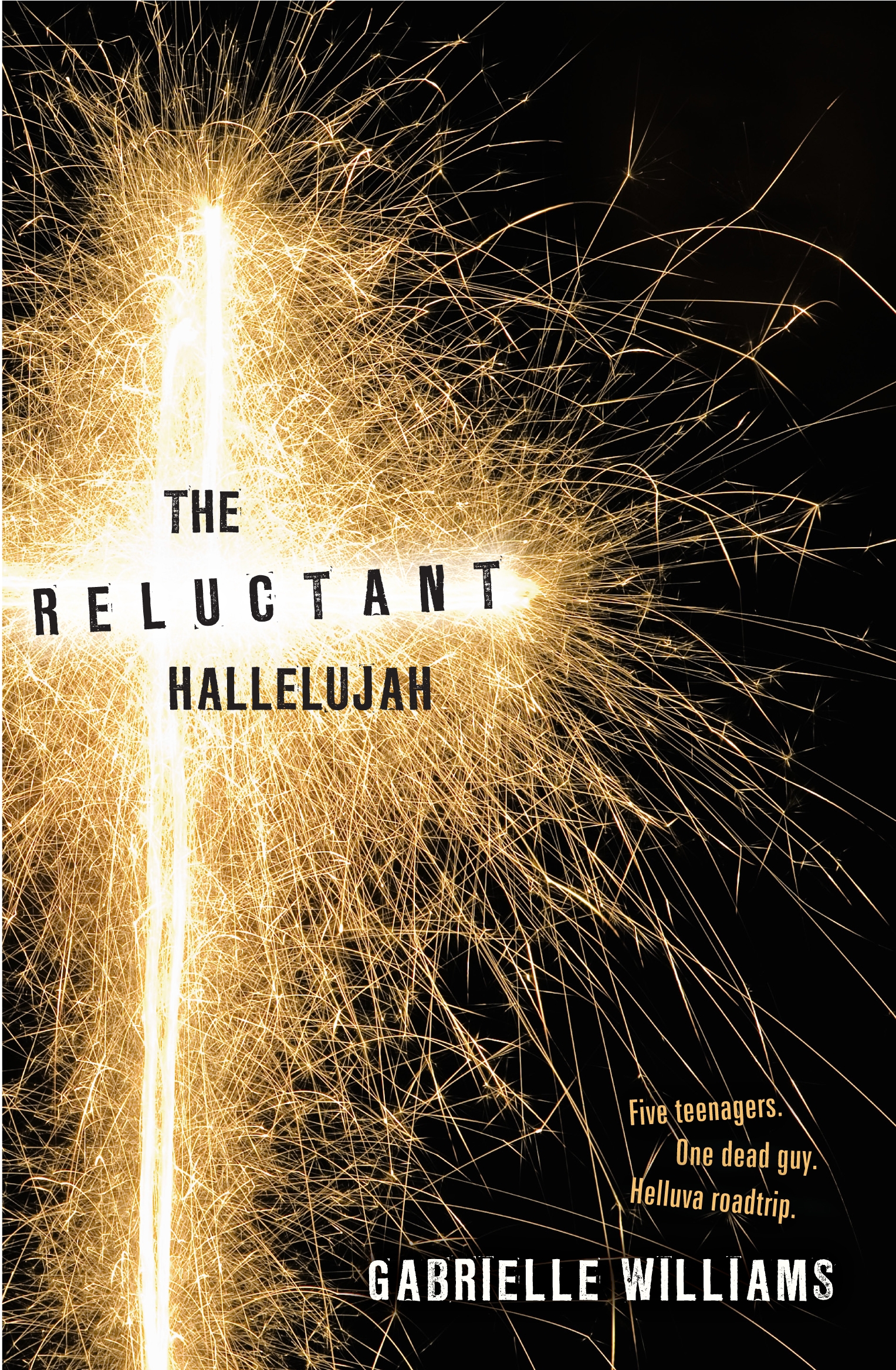
I loved Gabrielle’s book, The Reluctant Hallelujah, so I was really interested to find out more about how the story came to be.  The starting point for the story was the Deltora Quest series and her son arguing for a 14-year-old going on a quest.  She thought it would be interesting to write a book that’s about a ‘real life’ quest.  What better time to send a group of teenagers on a quest than just before exams, when the stress levels are high.  Gabrielle then had to think why they would be going on a quest; money’s boring, nuclear war has been done.  She wanted it to be something really massive and important, so she chose the body of Christ (although it could have been any iconic religious figure).  She thought that a lot of the story had to be ‘how come the body of Christ was in their house?’  Gabrielle is Catholic, so she felt confident ‘treading on a few toes, but not breaking them.’

Gabrielle deliberately kept the Jesus element quite minimal, it was more about the kids’ relationship to him.  There’s no magic in the story, apart from the fact that Jesus is perfectly preserved.  Gabrielle says ‘It is more a story about faith and the importance of doing something that is bigger than yourself. Sometimes you can go on an adventure that’s not about you, but something much bigger.’

If you haven’t read The Reluctant Hallelujah, grab a copy straight away.  You won’t be disappointed!


Reading Matters 2013 – Highlights #5

IMG_0293

My life in comics – Raina Telgemeier

Raina Telgemeier’s session kicked off day two of Reading Matters and it was the perfect way to get everyone in the mood for another day of bookish delights.  Raina started by talking about her influences, which include cartoons from her childhood (Smurfs, Strawberry Shortcake and Scooby Doo), books by Roald Dahl and her favourite book, Mrs Frisby and the Rats of Nimh by Robert C. O’Brien.  As a graphic storyteller there are quite a few graphic novels that have influenced her, including  Calvin and Hobbs, For Better or Worse by Lynn Johnston, the Bones graphic novels by Jeff Smith, and Barefoot Gen, a cartoon story of Hiroshima which made her realise that comics could tell powerful stories.

Raina’s first graphic novel, Smile, is a love letter to her home town San Francisco and ’90s fashion.  She says that she ‘wrote this story just to get the memories out if my head.’ Her family members became a huge part of the story (it’s autobiographical) and they love being cartoon characters.  Every character in the story has a route in a real person.  It seems to have really struck a chord with her readers as she has heard from lots of boys and girls who have been with something very similar.  Raina wishes that she could ‘go back in time and tell her 12 year old self that it would be OK.’

Drama was inspired by her time as a theatre nut.  It includes ‘stage fright, annoying brothers, mean girls, cute boys, school dances and bubble tea.’

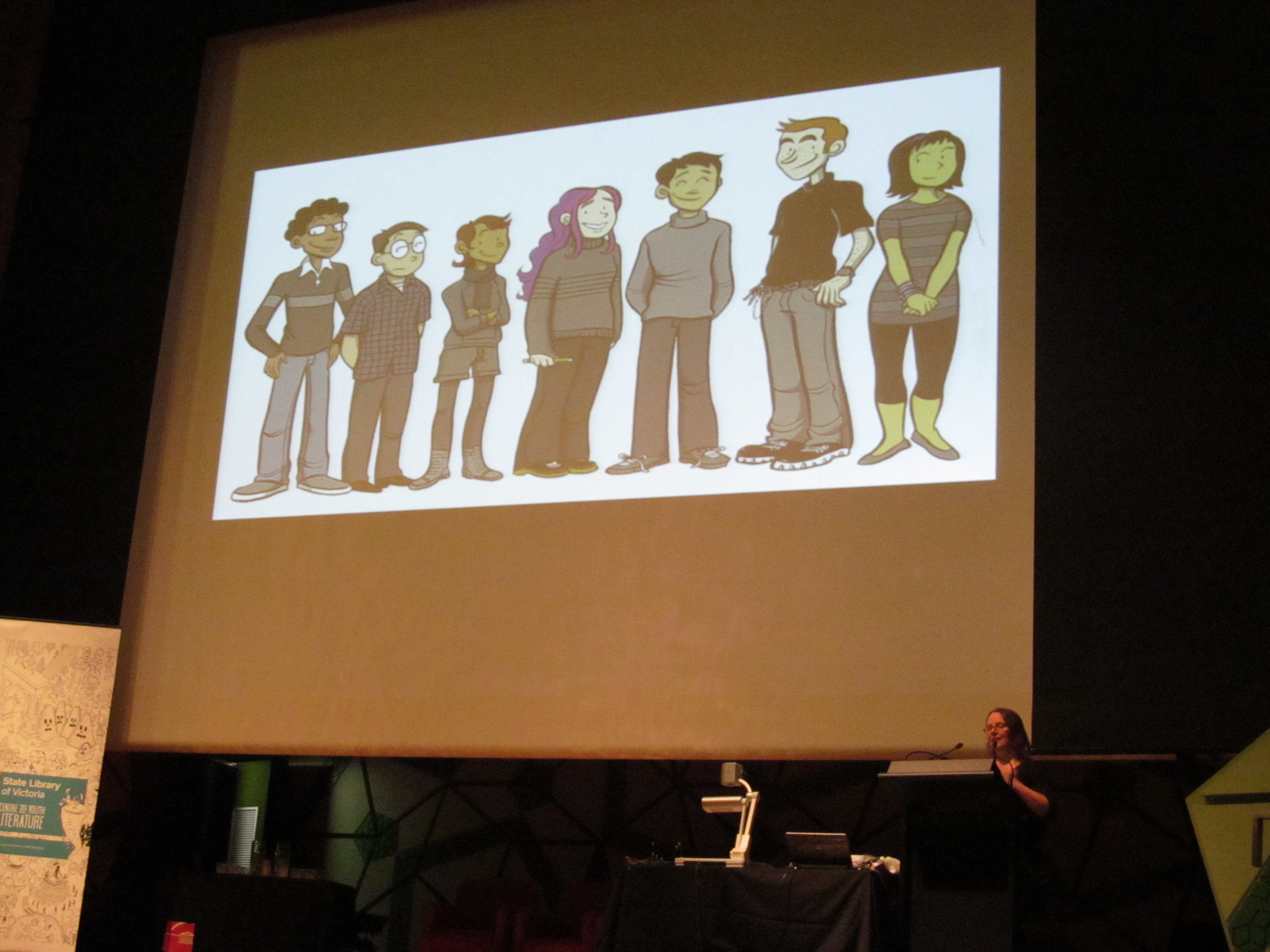
Raina took us through the different stages of putting a graphic novel together.  First, she creates thumbnail sketches of each page, in which she decides where characters will stand and where the action will take place.  Next, she does the penciling (where she spends more time on the artwork), inking (using a watercolour brush and ink), digitization, colouring, cover design, and the mock-up of the final jacket.

I loved Raina’s explanation of why she creates graphic novels, ‘I wanted to see myself, my friends and family, in comics.’ She believes that ‘kids need role models of kids who are just good people.’ I wholeheartedly agree with this!

Raina’s next book is a companion to Smile, called Sisters (coming in 2014), which will be stories about Raina and her sister.

Check out some photos of Raina’s live drawing that she did while answering questions from the audience. So cool!


Reading Matters 2013 – Highlights #4

IMG_0283

You can’t say that! – Parental guidance recommended with Libba Bray, Vikki Wakefield and Gabrielle Williams

This session was a great way to end the first day of Reading Matters as it was absolutely hilarious!  I haven’t read any of Libba Bray’s books but I will have to remedy this immediately.  I’m a huge fan of Vikki Wakefield and Gabrielle Williams so I was really looking forward to hearing all about their books.  Each of the authors were asked if they had been asked to cut something out of a book or not write about a subject.  Libba said that she had never been told not to do something in a book, but she had been asked to ‘cut the talking penis scene in Going Bovine.’  Gabrielle’s latest book, The Reluctant Hallelujah (an amazing book about finding Jesus in the basement) hit some roadblocks in the publication process.  Her publisher was reluctant to publish it in Australia and her US publisher suggested changing the body of Jesus to the body of Elvis. Gabrielle writes comedy because she likes it, and this is one of the things I like most about her books.  She doesn’t approach issues in her books, instead she likes to make her characters three-dimensional so that the issues come to the characters.

Vikki Wakefield goes full-on with her stories and keeps going until it makes her laugh or cry. Someone needs to tell her when she’s gone too far.  She set out to be subversive with her first novel, but it wasn’t.  She pushed further emotionally with Friday Brown (and if you’ve read Friday Brown I think Vikki hit the nail on the head!).  Vikki suggested that there is a fear in white writers of writing indigenous characters, which means they’re disappearing. She believes that writers need to be taking more of a risk when it comes to this.

The next books they’re working on are:

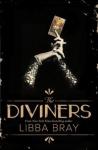
  • Libba Bray – sequel to The Diviners
  • Vikki Wakefield – a love story from a duel point of view
  • Gabrielle Williams – a story set in 1986 with four characters, two aged 17 and two aged 23.
Me and Vikki Wakefield (author of Friday Brown)

Me and Vikki Wakefield (author of Friday Brown)

Reading Matters 2013 – Highlights #3

IMG_0270

Gatekeepers: the good, the bad and my mother – Keith Gray

I hadn’t read any of Keith Gray’s books before Reading Matters but, now that I’ve met him, I want to read all of his books.  I had heard him talk at the Unconference on Thursday and his talk really struck a chord with me.  On Friday he talked about the gatekeepers of young adult literature.  He started by telling us a hilarious story about a ladder that he bought and the 18 different instructions that he was supposed to read before he used the ladder.  Like the rules that were a barrier to him using the ladder, the gatekeepers of young adult literature are a barrier to teenagers discovering books.  These ‘gatekeepers’ are publishers, librarians, teachers, parents and grandparents, and if one of these people takes offense at a book they can close the gate to teenagers.  These gatekeepers are looking out for the ‘f-bomb’ and other language that they find offensive, and sex (which Keith says will have them ‘not just barring the gate, but melting down the key’).

Keith suggests that the ‘best books allow you to explore things on your own two feet.’  He trusts his readers to be able to think about big, tough issues and use their own judgement.  He says that reading is ‘about learning empathy and opening your mind.’ I know I certainly wouldn’t be the same person without learning these things through books.

One of the things I really like about Keith is that he writes specifically with teenage boys in mind as his readers.  He mentioned that he likes to portray teenage males as thinking and feeling humans that show emotion.  As a male I hugely appreciate reading about those types of male characters in books, because I can really relate to them.  They are the sorts of characters who really stick in my mind because I have a connection with them.

Keith finished by saying that ‘readers are the best gatekeepers.’  We can be a bit overprotective of teenage readers and we need to learn to trust them.  They’ll decide for themselves what they do or don’t like, just as we do as adults.

Reading Matters 2013 – Highlights #2

IMG_0262

Is there an app for that? – Paul Callaghan, John Flanagan and Fiona Wood talk stories and communities in a brave new world

This was a really interesting session that looked at the extensions to the book world, including apps, websites and social media.  John Flanagan is the author of the Ranger’s Apprentice and Brotherband series and there is a huge fan base for his books.  As well as numerous websites and apps there are events held all over the world that offer fans real life experiences of the world of the books.  Fiona Wood talked about expectation and desire for writers to be accessible, both from their publishers and from readers.  She says that having this presence online will attract interest from readers too.  There are challenges with setting up an online presence with blogs and social media, because you have to construct a persona that is who you are, while also respecting the privacy of family and friends.

John and Hank Green’s Nerdfighters was held up as a shining example of how well this online presence can work.  They have millions of fans and followers from all over the world. Fiona agreed that the Nerdfighters do alot of good, but she want ‘to see a movie where the Green brothers turn evil’ (I would definitely love to see that). While these authors could only dream of the Green brothers’ massive success, they all agreed that audiences want a sense of connection to another person, no matter what the format.

The most interesting question of this session was ‘Are apps the death of the imagination?’ John suggested that there are a raft of games with instant gratification.  You get a medal of some sort each time you finish the level so you’re not striving for anything.  John was very pleased that, through his books, he managed to get a kid ‘off his bum and away from a computer.’  He got an email from a reader who got so into the Ranger’s Apprentice books that he was always out in the woods behind his house with a crossbow, instead of sitting in his room playing computer games.  However, John fears the inevitable Ranger’s Apprentice movie.  He loves that every reader sees the world of his books differently inside their head and a movie could change this.  Paul Callaghan believes that games can expand imagination in completely new ways.

Reading Matters 2013 – Highlights #1

IMG_0258

Action! – Gayle Forman, Tim Sinclair and Raina Telgemeier discuss the highs and lows of teen life

The first question for the authors was why do they depict the teen experience? What is it about YA that appeals to them? I guess I’ve always just thought that it was the story they wanted to write (and this is apart of it), but they gave some great reasons.  Tim said he thought grownups were boring because they slowly angst about things that they can’t change.  Raina remembers every detail about her teenage years so it’s easy to write about it.  Alot of these details of her teenage life makes it into her books.  Gayle writes ‘about young people, but not young stories’ and she said that writing for teens was a way to relive her teenage years.  Characters between the ages of 17 and 22 often invade her brain so she has to write about them.

Each of the authors felt that they had different responsibilities as a writer of books for teens.  Gayle said that it’s important to ‘tell an emotionally authentic story.’  Raina believes that it’s important to write books for teens who don’t enjoy reading.  It’s her responsibility to hook those teenagers who haven’t ‘found’ books yet.  It was at this point that Gayle talked about the importance of librarians and came out with one of my favourite lines of the conference, ‘Librarians are crack dealers.’ It’s our job to get teenagers addicted to books and coming back to the library to get their next fix.

There was also some discussion about labels. Raina hates the way that people dismiss her books as children’s or YA, or when they say it’s ‘just a comic.’ Tim hates the ‘poet’ label.  He wouldn’t want his books (which are verse novels) put in the poetry section of a bookshop because ‘that’s where books go to die.’ When they were asked if YA is a genre or a readership, Tim quickly replied that YA is ‘just awesome!’

The next books they’re working on are:

  • Gayle Forman – a novel called ‘A Code Unknown’: a suicide/mystery/love-story.
  • Tim Sinclair – a ‘novel-novel’ and that’s all he’ll say.
  • Raina Telgemeier – a companion novel to ‘Smile’, called ‘Sisters’ coming 2014

The 2013 Inky Awards Longlist

One of the coolest things about being at Reading Matters was hearing the live announcement of the 2013 Inky Awards longlist (especially when many of the authors on the list were in the audience).  The Inky Awards are the Australian teen choice book awards for teen literature, voted for online by the readers of insideadog.com.au, and named after the site’s wonder-dog, Inky. There are two awards: the Gold Inky for an Australian book, and the Silver Inky for an international book.  Check out the visual longlist below and go to insideadog.com.au  for more information about each of the books.

Gold Inky Longlist


Silver Inky Longlist

What are your favourites?  I’m actually glad I can’t vote because I’d have a real problem trying to chose my favourite, especially the for Gold Inky.  So many great books!

We seriously need to set up a teen choice book award in New Zealand.  I may need to start a petition and send it to Storylines.

YA Authors Assemble – Reading Matters is nearly here!

I am buzzing with excitement because in a few days some of the best YA authors around will gather in Melbourne for Reading Matters and I will be there.  I’ve wanted to go to Reading Matters for years and registered as soon as I possibly could (without even knowing which authors would be there).  In the past they’ve had some incredibly cool authors, including John Green, so I knew they would have some amazing authors this year.  When the author lineup was announced I was actually jumping up and down with excitement!

I will get the chance to meet some of my favourite Australian YA authors and some great international authors too.  My suitcase will be packed with books to get signed and I’m sure to come back with a few others.  Some of the authors I’m most looking forward to meeting are Morris Gleitzman, Vikki Wakefield, Gabrielle Williams, Myke Bartlett and Keith Gray.

These are just a couple of the sessions that sound totally awesome:

  • Everyone’s a critic – Myke Bartlett, Alison Croggon and Morris Gleitzman on setting their stories free.
  • You can’t say that! – Parental guidance recommended with Libba Bray, Vikki Wakefield and Gabrielle Williams.
  • Gatekeepers – the good, the bad and my mother – Keith Gray

I’ll take lots of photos, try to Tweet as much as possible and will blog about my favourite sessions when I get home.

Melbourne here I come!